What is a katori? Size, grams, and calories
The small thali bowl, and what it actually weighs. See also: why published Indian nutrition numbers disagree.
By Shivam Verma Updated
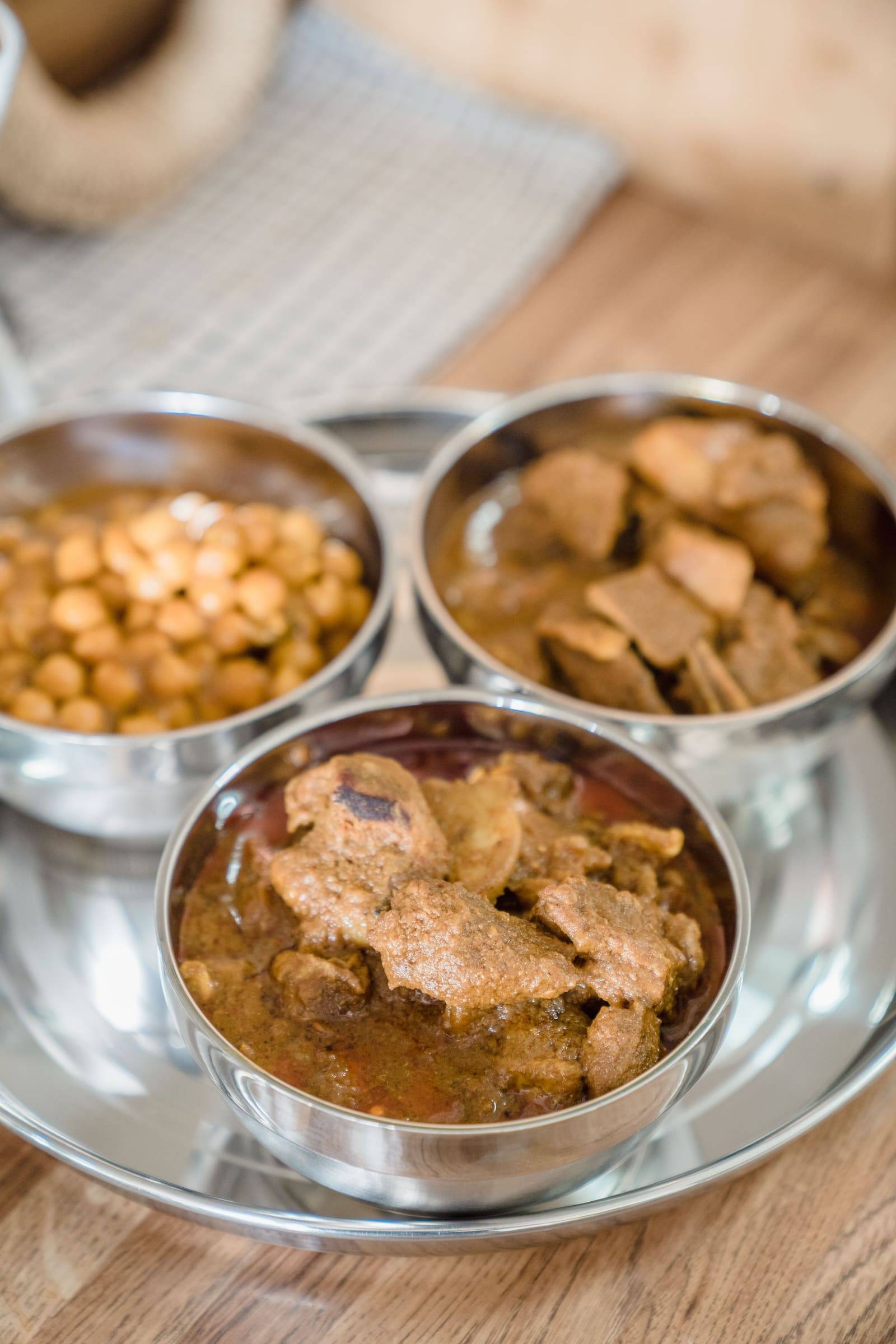
A katori is the small round bowl on every Indian thali. India's dietary guidelines suggest measuring katoris from 115 ml to 360 ml, and this site counts a katori as 150 ml, our stated basis. The catch, and the reason people search this, is that millilitres are not grams: 150 ml of liquid dal, curd or sambar weighs close to 150 g, and this site counts a katori of dal or curry as 150 g. A level 150 ml katori of cooked long-grain rice, the basmati type, weighs about 99 g by USDA's figure of 158 g per cup, and medium-grain rice such as sona masoori is closer to 116 g. This site counts a katori of rice as 120 g, a little above level: our stated assumption. When a number matters, measure your own katori once, then you can eyeball it.
Founding 500
Snap your katori and Katori works out the grams for you.
Katori is an iPhone app that counts your actual plate from one photo. Built for Indian food first.
No spam. One email at launch, then only if it matters. Privacy.
First 500 sign-ups get the badge, paid or free. 10% off Pro annual, expires 30 days after launch, replaces the trial.
Katori sizes
India's dietary guidelines, from ICMR's National Institute of Nutrition, suggest four measuring katoris: a large katori of 360 ml, a medium one of 200 ml and two small ones of 155 ml and 115 ml. The 150 ml katori this site counts by is within 5 ml of the guidelines' 155 ml small katori.
| Katori | Volume | US cups | Metric cups | Tablespoons |
|---|---|---|---|---|
| Large katori (C6) | 360 ml | 1.5 | 1.44 | 24 |
| Medium katori (C7) | 200 ml | 0.83 | 0.8 | 13.3 |
| Small katori (C8) | 155 ml | 0.65 | 0.62 | 10.3 |
| Small katori (C9) | 115 ml | 0.48 | 0.46 | 7.7 |
Volumes and codes as Annexure I of the ICMR-NIN Dietary Guidelines for Indians, 2024 gives them; the same annexure counts a tablespoon as 15 g and a teaspoon as 5 g. The other columns are computed: a US cup of 240 ml, the FDA labelling cup, a metric cup of 250 ml and a tablespoon of 15 ml.
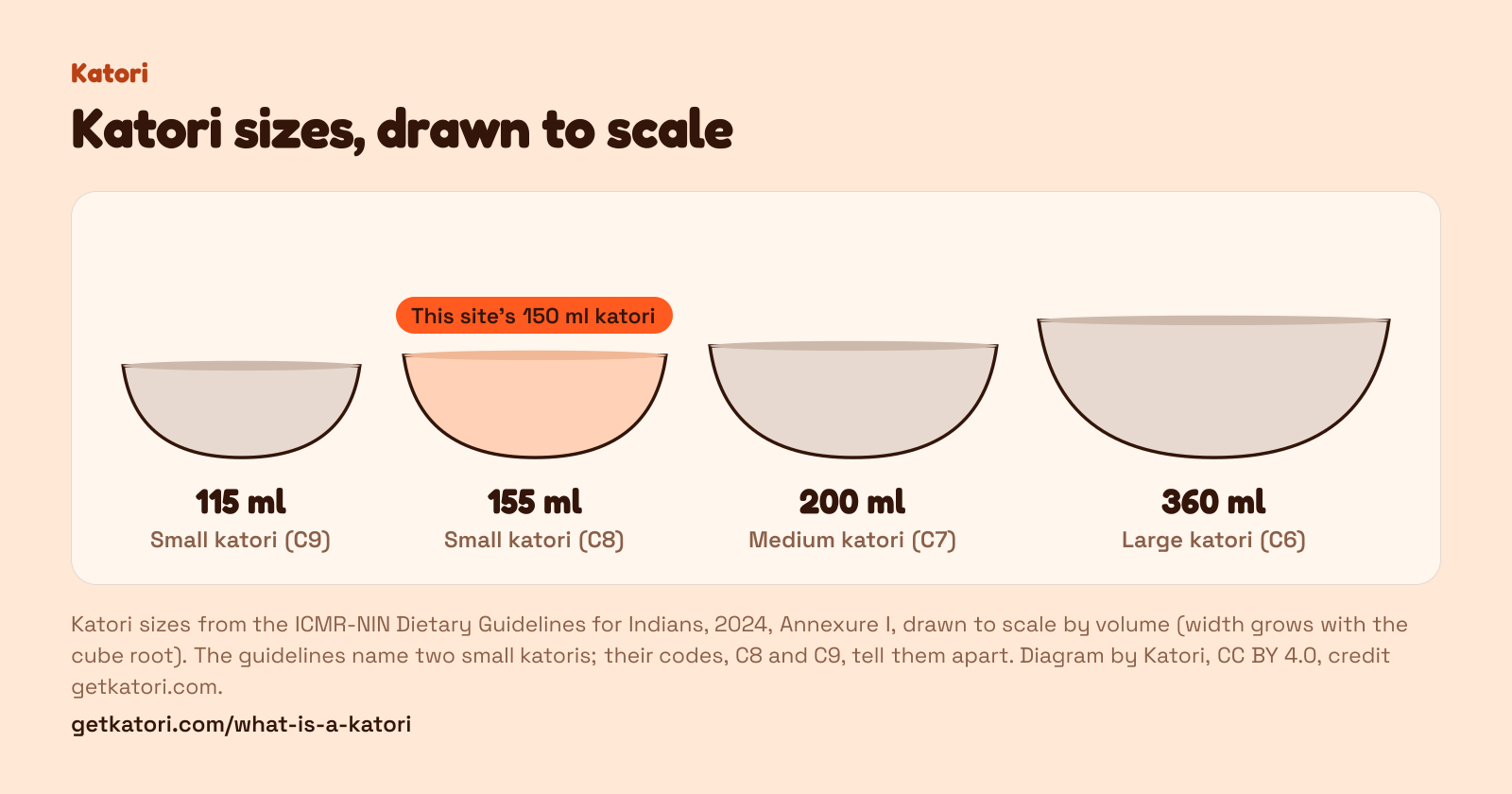
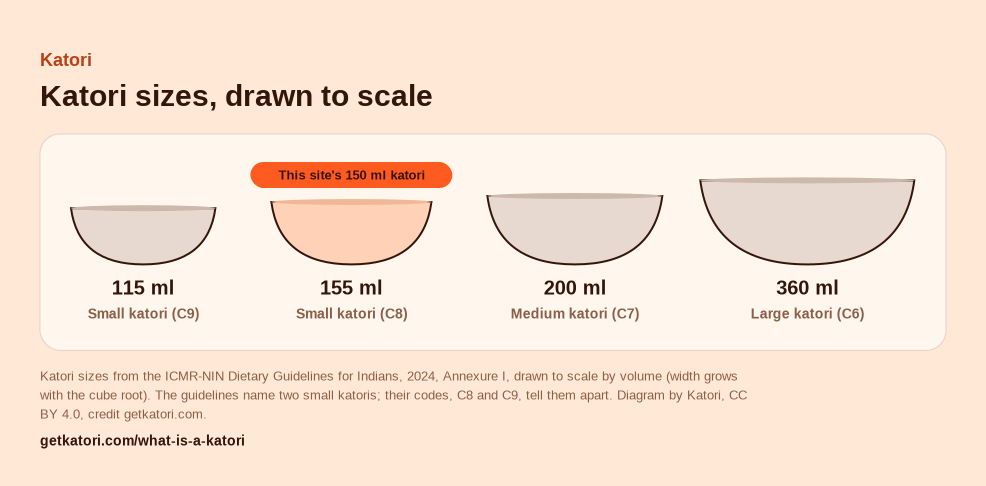
<a href="https://getkatori.com/what-is-a-katori"><img src="https://getkatori.com/what-is-a-katori/katori-sizes.png" width="1600" height="840" alt="Four katori sizes drawn to scale by volume: 115, 155, 200 and 360 millilitres. This site's 150 ml katori is marked on the 155 ml bowl." style="max-width:100%;height:auto"></a>
<p>Katori size diagram: <a href="https://getkatori.com/what-is-a-katori">Katori, getkatori.com</a>, licensed <a href="https://creativecommons.org/licenses/by/4.0/">CC BY 4.0</a>.</p>
The embed code carries the credit the licence asks for. The diagram, the calorie chart and the dataset are all listed, with their licence, on the data and downloads page.
A one-page handout of these sizes, with cups, tablespoons and ten dishes by the katori: PDF, US Letter or PDF, A4. CC BY 4.0, credit getkatori.com.
Correction, November 7, 2026: the katori size table on the katori guide now follows the ICMR-NIN Dietary Guidelines for Indians, 2024 (Annexure I). The size chart it replaces gave ranges with no cited measurement.
How many grams is 1 katori, by food
The same katori weighs differently with each food in it. Each row is a level katori, worked out from USDA's own weight for a US cup of that food, 240 ml, at the guidelines' four sizes and ours.
| Food | 115 ml | 150 ml (ours) | 155 ml | 200 ml | 360 ml |
|---|---|---|---|---|---|
| Cooked rice, long-grain | 76 g | 99 g | 102 g | 132 g | 237 g |
| Cooked rice, medium-grain | 89 g | 116 g | 120 g | 155 g | 279 g |
| Curd (plain whole milk yogurt) | 117 g | 153 g | 158 g | 204 g | 368 g |
| Whole milk | 117 g | 153 g | 158 g | 203 g | 366 g |
| Whole wheat flour (atta) | 58 g | 75 g | 78 g | 100 g | 180 g |
| Sugar | 96 g | 125 g | 129 g | 167 g | 300 g |
| Ghee | 98 g | 128 g | 132 g | 171 g | 308 g |
What this site counts in a katori
Counting a whole meal in katoris? The calorie calculator adds them up, in katoris or cups. Each dish page counts a 150 ml katori at the weight below.
| Food | Weight | Note |
|---|---|---|
| Dal, sambar, curd (liquid) | 150 g | Weight tracks the volume closely |
| Cooked rice | 120 g | A little above level, our assumption |
| Curry, paneer or chicken gravy | 150 g | The katori every curry page counts |
| Chana masala, whole beans | 150 g | Beans plus gravy |
| Gajar halwa | 150 g | The sweet counted by the katori |
Calories in 1 katori, every dish
Every dish this site counts by the katori, 24 of them today, lightest first. Each figure is one katori as cooked at home, from that dish's own recipe, and the list grows as dishes are added.
| Dish | Katori | Calories | Protein |
|---|---|---|---|
| Sambar | 150 g | 109 | 4.5 g |
| Urad dal | 150 g | 152 | 9.3 g |
| Toor dal | 150 g | 153 | 8.0 g |
| Moong dal | 150 g | 155 | 8.8 g |
| Rice | 120 g | 156 | 3.2 g |
| Dal makhani | 150 g | 162 | 7.4 g |
| Veg pulao | 120 g | 167 | 3.1 g |
| Chicken curry | 150 g | 170 | 14.7 g |
| Masoor dal | 150 g | 176 | 9.1 g |
| Chicken tikka masala | 150 g | 178 | 18.3 g |
| Dal tadka | 150 g | 181 | 8.4 g |
| Jeera rice | 120 g | 181 | 3.3 g |
| Chana dal | 150 g | 182 | 7.8 g |
| Chicken korma | 150 g | 211 | 16.3 g |
| Soya chaap | 150 g | 216 | 9.4 g |
| Palak paneer | 150 g | 221 | 13.1 g |
| Matar paneer | 150 g | 228 | 12.0 g |
| Butter chicken | 150 g | 231 | 16.5 g |
| Upma | 150 g | 235 | 6.6 g |
| Chana masala | 150 g | 237 | 8.7 g |
| Kadai paneer | 150 g | 245 | 12.5 g |
| Shahi paneer | 150 g | 283 | 14.4 g |
| Paneer butter masala | 150 g | 313 | 13.8 g |
| Gajar halwa | 150 g | 347 | 7.7 g |
Protein in 1 katori of rice and of dal
A katori of plain rice, 120 g, has 3.2 g of protein. A katori of everyday dal has 7.8 to 9.1 g, so dal and rice together, the plate most Indian homes eat, carry 11.0 g or more. The dal brings most of it.
Whether the rice is a good choice is a separate question, and what tests found for basmati answers it with its own sources.
How to measure your own katori in one minute
You need a measuring jug, or a kitchen scale, and water. Fill your katori with water to where you would fill it with dal, not to the brim, and pour it into the jug: that reading is your katori in millilitres. With a scale, weigh the empty katori, fill it the same way and weigh it again; a gram of water is a millilitre, so the difference is your katori's size.
If yours holds about 150 ml, the katori figures on this site fit it as they are. If it holds the guidelines' medium 200 ml, a katori from your bowl carries about 1.3 times what our katori figures count; multiply by the ratio of your katori to ours.
Weighing your katori is the first of five steps in our tracking guide.
Sources
- USDA FoodData Central
- IFCT 2017, Indian Food Composition Tables. ICMR-National Institute of Nutrition.
- USDA FoodData Central. SR Legacy 168878: Rice, white, long-grain, regular, enriched, cooked
- USDA FoodData Central. SR Legacy 168880: Rice, white, medium-grain, enriched, cooked
- USDA FoodData Central. SR Legacy 171284: Yogurt, plain, whole milk
- USDA FoodData Central. SR Legacy 171265: Milk, whole, 3.25% milkfat, with added vitamin D
- USDA FoodData Central. SR Legacy 168893: Wheat flour, whole-grain (Includes foods for USDA's Food Distribution Program)
- USDA FoodData Central. SR Legacy 169655: Sugars, granulated
- USDA FoodData Central. SR Legacy 173412: Butter oil, anhydrous
- US Food and Drug Administration. Guidance for Industry: Guidelines for Determining Metric Equivalents of Household Measures. Content current as of November 10, 2017.
- ICMR-National Institute of Nutrition. Dietary Guidelines for Indians, 2024, Annexure I.
Common questions
What is a standard katori size?
There is no single standard. The ICMR-NIN Dietary Guidelines for Indians, 2024 suggest four measuring katoris: a large katori of 360 ml, a medium one of 200 ml and two small ones of 155 ml and 115 ml. This site counts a katori as 150 ml, our stated basis, within 5 ml of the 155 ml one.
How many grams is 1 katori?
This site counts a katori as 150 ml, our assumption, which is close to 150 g for liquids like dal and curd; it counts a katori of dal or curry as 150 g. A level 150 ml katori of cooked long-grain rice, the basmati type, weighs about 99 g by USDA's figure of 158 g per cup, and medium-grain rice such as sona masoori is closer to 116 g. This site counts a katori of rice as 120 g, a little above level: our stated assumption. It depends on what fills the bowl, because millilitres measure volume and grams measure weight.
Is 1 cup equal to 1 katori?
No. A US cup is 240 ml by the FDA's labelling rule, 1.6 of our 150 ml katoris. The guidelines' medium katori, 200 ml, comes closest, at 0.83 of a cup.
What is 1 bowl in ml?
A bowl has no fixed size. The guidelines' katoris run from 115 ml to 360 ml, a US cup is 240 ml and a UK, Canadian or Australian cup 250 ml. Fill yours with water and measure it once.
Is a bowl the same as a katori?
Not usually. Katori refers to the small round thali bowl, which this site counts as 150 ml. A generic bowl or a restaurant serving bowl can be bigger, so a bowl of dal can hold more than a katori of dal. The word you use changes the calories.
How much protein is in 1 katori of rice?
About 3.2 g in a 120 g katori of plain cooked rice. A katori of moong dal has 8.8 g.
What does one katori mean?
One small bowl's worth, the way food is served on a thali. On this site it means 150 ml, and each dish page states the grams that fill it.
How many tablespoons are in a katori?
About 10 in our 150 ml katori, at 15 ml a tablespoon. The guidelines' katoris hold from 7.7 to 24.
These figures are estimates from stated recipes, for general information. They are not medical or dietary advice. If you manage a health condition, check with a registered dietitian or your doctor.
Founding 500
Be one of the original 500.
Permanent badge, plus 10% off your first year of Pro.
Snap one photo and get these numbers for your actual katori, not a guess.
No spam. One email at launch, then only if it matters. Privacy.
First 500 sign-ups get the badge, paid or free. 10% off Pro annual, expires 30 days after launch, replaces the trial.