Gajar halwa calories: 1 katori, 1 cup and 100 g
By Shivam Verma Updated 12 sources linked below
One katori (150 g) of gajar halwa has about 347 calories, or 231 per 100 g. One cup (240 g) has about 555. A katori holds 23.1 g of added sugar, about 5.5 teaspoons, and 7.7 g of protein from the milk and the carrots.
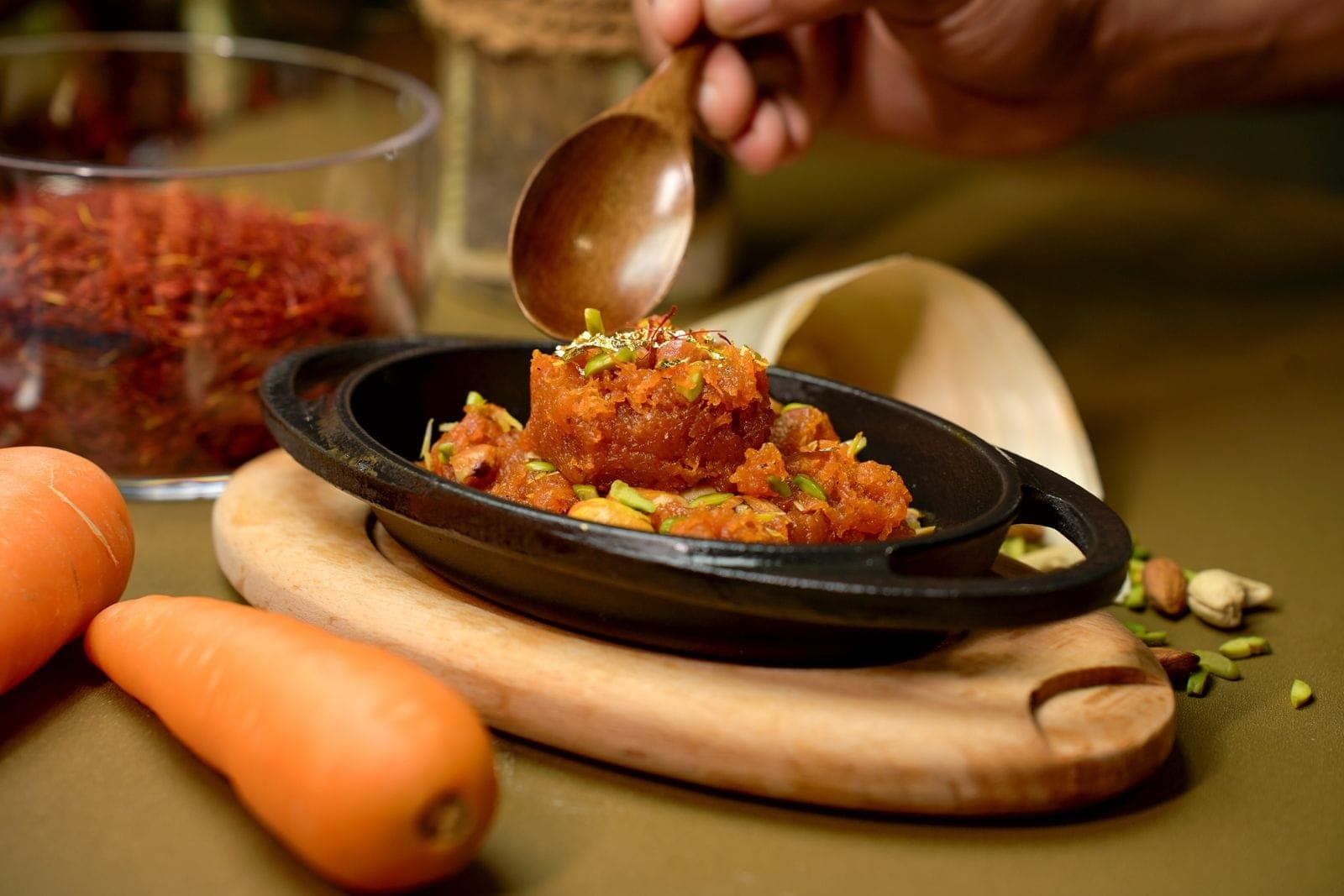
347calories
Protein
7.7 g
Carbs
43.7 g
Fat
16.8 g
1 cup = a 240 ml US cup of the dish as served. UK, Canadian and Australian cups are 250 ml: add about 4%.
Founding 500
Your katori of gajar halwa is not exactly 150 g.
Katori is an iPhone app that counts your actual plate from one photo. Built for Indian food first.
No spam. One email at launch, then only if it matters. Privacy.
First 500 sign-ups get the badge, paid or free. 10% off Pro annual, expires 30 days after launch, replaces the trial.
About gajar halwa
Also called gajar ka halwa and carrot halwa.
Gajar halwa is grated carrot cooked slowly in milk until the milk is absorbed. Sugar, ghee and milk powder go in next, the milk powder standing in for khoya, and almonds go on top. Our home batch starts as 1,190 g of raw ingredients: 500 g of carrots, 500 g of milk, 100 g of sugar, 40 g of ghee, 40 g of milk powder and a few almonds. Cooking drives off about 540 g of water and leaves 650 g. That cook-down is our assumption; your pan may stop sooner or later. Of the calories, 26 percent come from the sugar, 23 percent from the ghee, 20 percent from the milk, 14 percent from the carrots, 13 percent from the milk powder and 4 percent from the almonds. It is a winter sweet, made from around Diwali into January. The other sweets we have built sit in the Sweets family on the calories hub.
Home vs sweet shop
Each katori here is 150 g of its own batch, so a richer batch packs more into the same bowl. The wedding or sweet shop style, with more ghee and milk powder, is 409 calories a katori. Leaving out the milk powder brings it to 321, and halving the sugar to 328.
| Version | Weight | Calories | Added sugar | Protein |
|---|---|---|---|---|
| HomeHeadlineCarrots, milk, sugar, ghee and milk powder. | 150 g | 347 | 23.1 g (5.5 tsp) | 7.7 g |
| Wedding or sweet shop styleMore ghee and milk powder: 70 g and 80 g in the batch. | 150 g | 409 | 20.8 g (5.0 tsp) | 9.1 g |
| Without milk powderThe same batch with no milk powder: lighter, with less protein. | 150 g | 321 | 24.6 g (5.9 tsp) | 5.6 g |
| Half the sugar50 g of sugar in the batch in place of 100 g. | 150 g | 328 | 12.5 g (3.0 tsp) | 8.3 g |
How much sugar is in a katori of gajar halwa
One katori holds 23.1 g of added sugar, about 5.5 teaspoons: more added sugar in one katori than two gulab jamuns, which hold 18 g. The carrots and the milk add 14.9 g of their own sugars, which none of the guidelines below counts as added.
| Guideline | What it says | One katori of gajar halwa, added sugar |
|---|---|---|
| World Health Organization | Free sugars under 10% of daily energy, ideally under 5%, which is about 25 g a day. | 23.1 g, 92% of 25 g |
| NHS (UK) | No more than 30 g of free sugars a day for adults. | 23.1 g, 77% of 30 g |
| American Heart Association | About 6 teaspoons of added sugar a day for women and 9 for men. | 5.5 tsp, against 6 (women) or 9 (men) |
| Heart & Stroke (Canada) | No more than 10% of daily calories from added sugars, ideally under 5%. On a 2,000 calorie day, 10% is about 48 g. | 23.1 g, 48% of 48 g |
| Australian Dietary Guidelines | Limit foods and drinks containing added sugars. No daily number is set. | 23.1 g |
Is gajar halwa healthy?
The carrots and the milk bring more than most sweets do. A katori has 7.7 g of protein, more than a rasmalai piece at 6 g, though a katori is also the bigger serving: 150 g against 80 g.
The raw carrots that go into one katori carry about 963 µg of vitamin A (RAE). Cooking changes how much of it survives, and we assume no figure for that, so it is an upper bound, not what you absorb.
The ghee is the other side: about 9.2 g of ghee in each katori, part of 16.8 g of fat. The practical lever is the sugar. The half-sugar row takes added sugar from 23.1 g to 12.5 g a katori.
If you manage blood sugar, ask your doctor or a registered dietitian how a sweet like gajar halwa fits into your plan.
What the carrots bring, and how to cut the sugar
Vitamin A: 963 µg RAE in the raw carrots that go into one katori, about 115.4 g of them, from USDA's record for raw carrots. Cooking changes how much of it survives, and we do not assume a figure, so treat this as an upper bound. For scale, the NIH Office of Dietary Supplements sets the adult RDA at 900 µg RAE for men and 700 µg for women.[7]
Halving the batch sugar, from 100 g to 50 g, takes a katori from 23.1 g of added sugar to 12.5 g, about 3 teaspoons. The calories fall less, from 347 to 328, because the smaller batch, 600 g in place of 650 g, packs more carrot, milk and ghee into each katori.
Leaving out the milk powder saves calories too, down to 321 a katori, but it takes protein from 7.7 g to 5.6 g. The wedding style goes the other way: 70 g of ghee and 80 g of milk powder in the batch make a katori of 409 calories and 23.6 g of fat. Its added sugar is a little lower, 20.8 g, because the same sugar is spread over a bigger batch.
For smaller portions, a tablespoon of 15 g is about 35 calories, and a cup is about 555. A katori holds 10 such tablespoons, which is why the bowl you serve matters more than the recipe. A cup here is a 240 ml US cup, counted at the same density as the katori: 150 g of halwa fills a 150 ml katori, so a cup holds about 240 g. Halwa packed down into a cup would weigh more. To count it with the rest of a meal, add gajar halwa to the calculator.
Two servings, compared
| Sweet | Two servings | Calories | Added sugar | Protein |
|---|---|---|---|---|
| Gulab jamun | 66 g | 188 | 18.0 g (4.3 tsp) | 4.9 g |
| Rasmalai | 160 g | 292 | 22.0 g (5.2 tsp) | 12.0 g |
| Kaju katli | 20 g | 98 | 8.2 g (1.9 tsp) | 2.1 g |
| Jalebi | 60 g | 198 | 19.2 g (4.6 tsp) | 1.6 g |
| Ladoo | 60 g | 298 | 19.6 g (4.7 tsp) | 6.2 g |
| Barfi | 60 g | 275 | 14.8 g (3.5 tsp) | 9.1 g |
| Gajar halwa | 300 g | 694 | 46.2 g (11.0 tsp) | 15.3 g |
Common questions
How many calories are in 100 g of gajar halwa?
About 231 calories, with 5.1 g of protein, 11.2 g of fat and 15.4 g of added sugar. A katori of 150 g is 347.
How many calories are in 1 cup of gajar halwa?
About 555 calories in a cup of 240 g, with 36.9 g of added sugar. We count a cup at the same density as the katori; halwa packed down into a cup weighs more.
How many calories are in 1 tablespoon of gajar halwa?
About 35 calories in a level tablespoon of 15 g.
How much sugar is in a katori of gajar halwa?
About 23.1 g of added sugar, 5.5 teaspoons, and 38 g of sugars in all once the carrots' and the milk's own are counted.
How do I make gajar halwa with less sugar?
Cut the batch sugar. Halving it, from 100 g to 50 g in our batch, takes a katori from 23.1 g of added sugar to 12.5 g. Add the sugar in parts and taste before adding the rest.
Can gajar halwa be made without sugar?
It can, but it will not be sugar free. The carrots and the milk carry 14.9 g of their own sugars in a katori, and those stay with no sugar added.
Does gajar halwa have vitamin A?
The raw carrots in one katori carry about 963 µg of vitamin A (RAE). Cooking changes how much of it survives, and we do not assume a figure, so treat that as an upper bound.
How many calories are in gajar halwa made with khoya?
We model khoya with milk powder, a stated assumption. Our closest figure for a khoya-rich halwa is the wedding or sweet shop style, with 80 g of milk powder and 70 g of ghee in the batch: 409 calories a katori.
How we calculated this
Every number on this page is for 1 katori (150 g), worked out from the recipe below.
- Carrots, grated500 g
- Whole milk500 g
- Sugar100 g
- Ghee40 g
- Milk powder40 g
- Almonds10 g
- Water lost while cooking down540 g lost
The whole home batch, which makes 650 g once the water has cooked off. One katori is 150 g of it.
Ingredient values from USDA FoodData Central (SR Legacy). Milk powder stands in for khoya. Vitamin A is the raw carrot figure from USDA, with no allowance for cooking.
Confidence: medium
Sources
- USDA FoodData Central 170393: Carrots, raw
- USDA FoodData Central 171265: Milk, whole, 3.25% milkfat, with added vitamin D
- USDA FoodData Central 169655: Sugars, granulated
- USDA FoodData Central 173412: Butter oil, anhydrous
- USDA FoodData Central 170876: Milk, dry, whole, with added vitamin D
- USDA FoodData Central 170567: Nuts, almonds
- NIH Office of Dietary Supplements. Vitamin A and Carotenoids: Fact Sheet for Health Professionals.
- World Health Organization. WHO calls on countries to reduce sugars intake among adults and children, 2015.
- NHS. Sugar: the facts.
- American Heart Association. Added sugars.
- Heart & Stroke. Reduce sugar.
- National Health and Medical Research Council. Australian Dietary Guidelines 1 to 5.
These figures are estimates from stated recipes, for general information. They are not medical or dietary advice. If you manage a health condition, check with a registered dietitian or your doctor.
Related dishes
Founding 500
Be one of the original 500.
Permanent badge, plus 10% off your first year of Pro.
Snap one photo and get these numbers for your actual plate, not a generic entry. Built for Indian food first.
No spam. One email at launch, then only if it matters. Privacy.
First 500 sign-ups get the badge, paid or free. 10% off Pro annual, expires 30 days after launch, replaces the trial.