Katori's Indian food nutrition dataset
Calories, protein, carbohydrate and fat for 63 Indian dishes, at home, in a restaurant and at a dhaba, each from a stated recipe valued with USDA FoodData Central. Free to use and adapt, with credit.
By Shivam Verma Updated
- Dishes
- 63
- Rows
- 128
- Version
- 2026.11.17
- Corrections logged
- 50
- Licence
- CC BY 4.0
Downloads
Full dataset (CSV)
128 rows, 19 columns: every published preparation, per 100 g figures and USDA record IDs.
Simple table (CSV)
63 rows, 7 columns: home cooking, one row per dish, the chart's rows.
README
Plain text: what the file is, every column, the licence and how to cite it.
Calorie chart (PDF)
Every dish on US Letter pages, grouped by family.
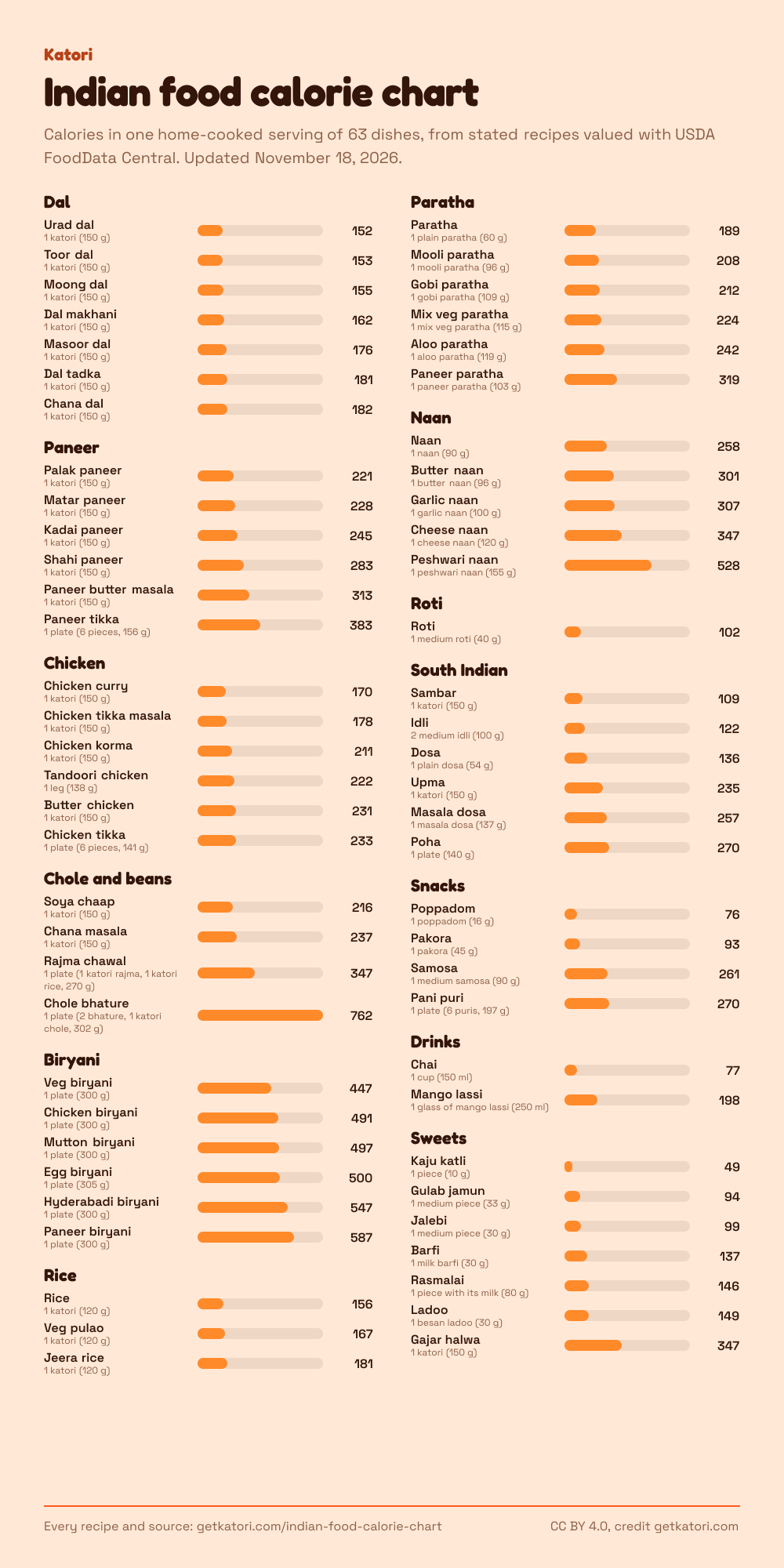
Calorie chart (image)
Every dish in one tall PNG.
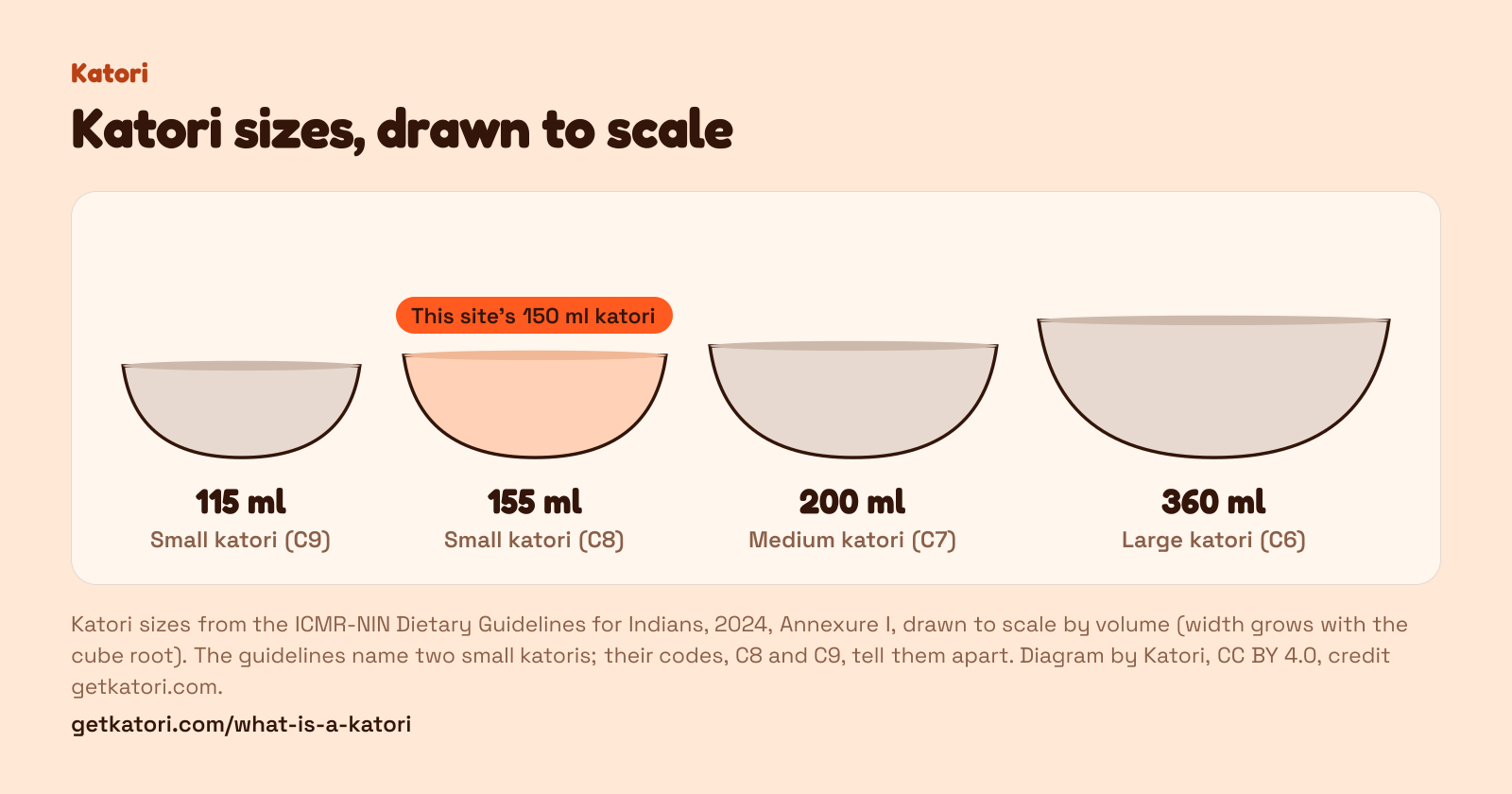
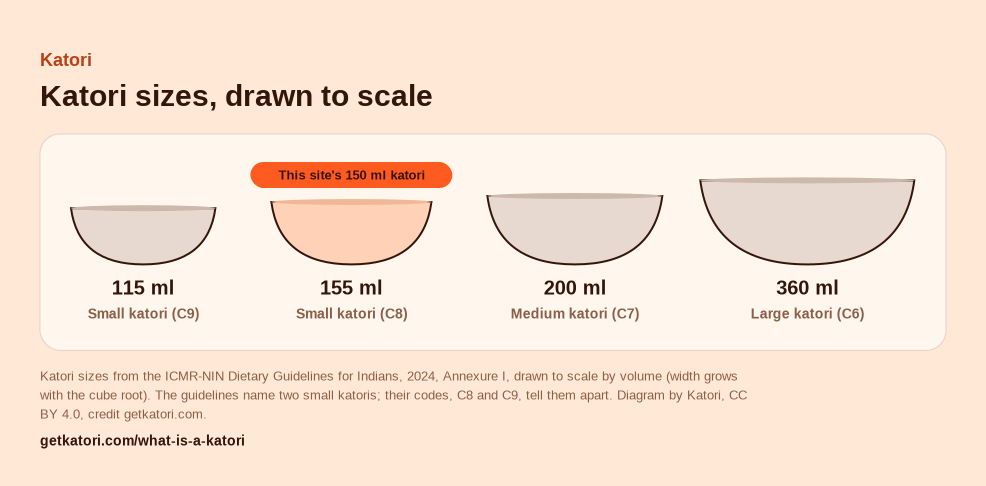
Katori size diagram (PNG and SVG)
The four guideline katoris drawn to scale. PNG at 1600 x 840.
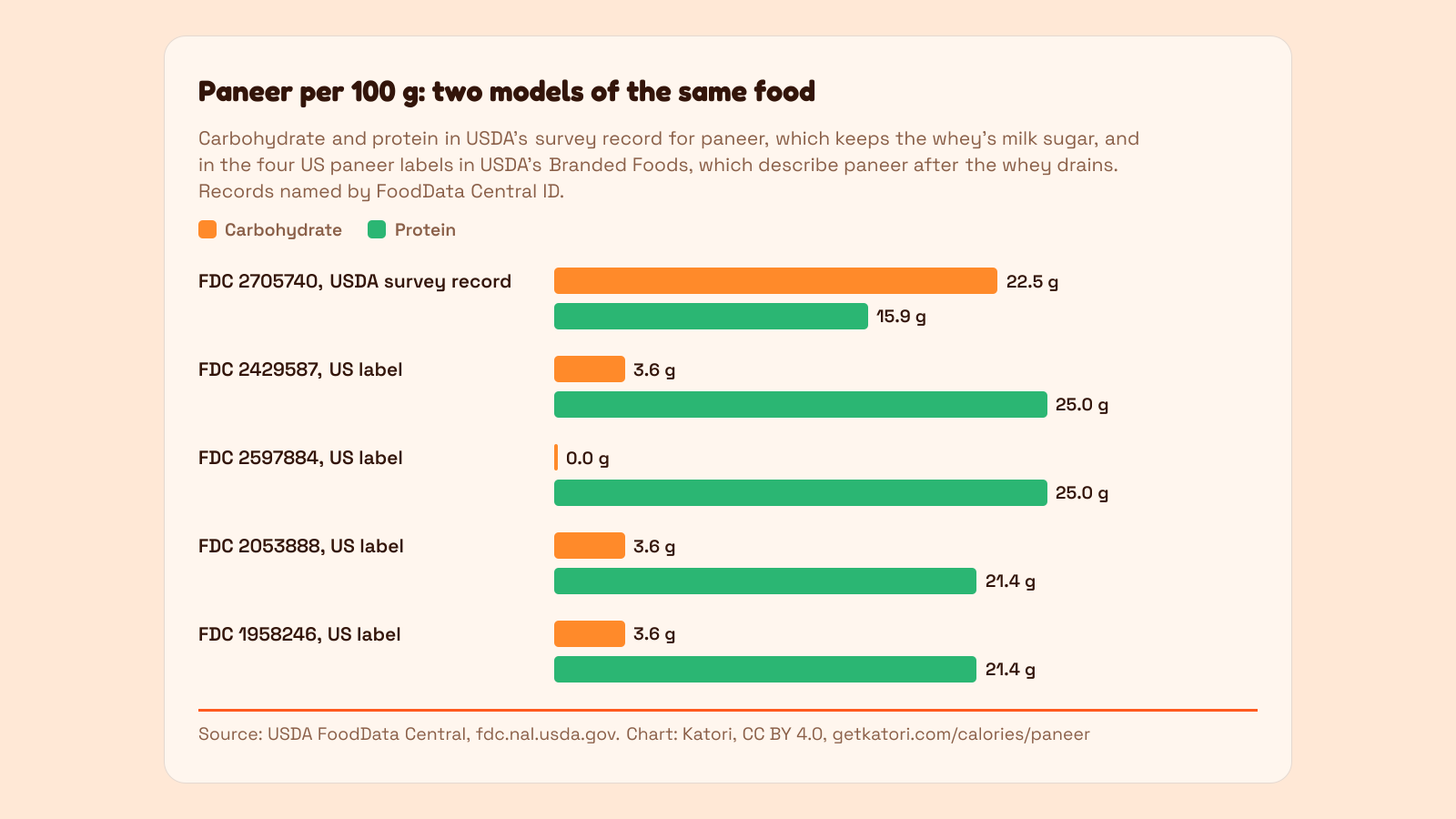
Paneer chart (PNG)
USDA's survey record against the four US paneer labels, carbohydrate and protein per 100 g. PNG at 1600 x 900.
Katori handout (PDF)
One page: the katori sizes in cups and tablespoons, and grams and calories for ten everyday dishes.
Also available on Zenodo (DOI), GitHub, Kaggle and Hugging Face.
Columns
The full dataset's 19 columns, in file order. The example is chole bhature cooked in a restaurant, as the file gives it.
| Column | What it holds | Example |
|---|---|---|
| dish | The dish, as its page and the calorie chart name it. | Chole bhature |
| slug | The dish's short id, the last part of its page address. | chole-bhature |
| family | The family the calorie chart groups the dish in. | Chole and beans |
| preparation | home, restaurant or dhaba: the kitchen the row's recipe describes. For a sweet, restaurant is the sweet shop version; for street food, the street version. | restaurant |
| serving | The serving the figures are for, in words, with its weight. | 1 plate (2 bhature, 1 katori chole, 308 g) |
| serving_g | The serving's weight in grams. A restaurant version can be served heavier than the home one. | 308 |
| serving_ml | The serving's volume in millilitres, for drinks. Empty for food. | (empty) |
| kcal | Calories in the serving, to the nearest whole number. | 877 |
| protein_g | Protein in the serving, in grams, to one decimal. | 18.3 |
| carbs_g | Carbohydrate in the serving, in grams, to one decimal. | 98.8 |
| fat_g | Fat in the serving, in grams, to one decimal. | 46 |
| kcal_per_100g | Calories in 100 g of the dish as served. | 285 |
| protein_g_per_100g | Protein in 100 g, in grams, to one decimal. | 5.9 |
| carbs_g_per_100g | Carbohydrate in 100 g, in grams, to one decimal. | 32.1 |
| fat_g_per_100g | Fat in 100 g, in grams, to one decimal. | 14.9 |
| fdc_ids | The USDA FoodData Central record IDs the row's recipe is valued from, separated by spaces, in recipe order. | 168894 171284 169655 173647 171411 173756 170000 170457 173410 170923 |
| confidence | high or medium: a plain judgement of how well the recipe is anchored. Not a statistical interval. | high |
| updated | The date the dish's page last changed, as YYYY-MM-DD. | 2026-11-12 |
| url | The dish's page, with its recipe, sources and every version. | https://getkatori.com/calories/chole-bhature |
How the numbers are made
Each dish is a stated recipe in grams. Every ingredient is valued from its own USDA FoodData Central record, the values are summed in code, and the totals are rounded once, at the end: calories to the nearest whole number, and protein, carbohydrate and fat to one decimal. The figures per 100 g come from the same unrounded totals, never from a rounded serving.
A row's preparation is the kitchen its recipe describes. The restaurant row is the dish as it is eaten out, at the weight that version is served at, and a dhaba row appears where the dish page publishes a dhaba version of its own. Where the kitchen does not change a dish, it has one row.
Every step, from the recipe to the rounding, is set out in how Katori calculates its numbers.
Known limits
- These are recipe estimates, not lab measurements of plates. A cook's hand with oil or ghee moves a dish more than any other ingredient.
- One recipe stands for each preparation. Real kitchens vary around it, and the dish page shows how far.
- The values are USDA's records, most of them for US foods. An Indian brand of an ingredient can differ.
- The calculator's dhaba estimate for a dish without a published dhaba version (the restaurant figure plus 6 g of ghee) is not in the file.
- The confidence label is a judgement of the recipe, not a statistical interval: no population of plates was sampled.
Licence and credit
The dataset, the calorie chart and the katori diagram are licensed CC BY 4.0: share and adapt them for any purpose, commercial included, as long as you credit them. Use this credit line, with a link to this page where you can.
Data: Katori Indian food nutrition dataset, getkatori.com/data (CC BY 4.0)Changes
This is version 2026.11.17, dated November 17, 2026: the version is the date the newest dish changed. When a published figure changes, the dish page that carried it says so, and the corrections log lists it: 50 corrections so far, across 41 dish pages corrected.
Sources
- USDA FoodData Central
- IFCT 2017, Indian Food Composition Tables. ICMR-National Institute of Nutrition.
These figures are estimates from stated recipes, for general information. They are not medical or dietary advice. If you manage a health condition, check with a registered dietitian or your doctor.
Founding 500
Be one of the original 500.
Permanent badge, plus 10% off your first year of Pro.
Snap one photo of your plate and the app counts it with these same recipes.
No spam. One email at launch, then only if it matters. Privacy.
First 500 sign-ups get the badge, paid or free. 10% off Pro annual, expires 30 days after launch, replaces the trial.