Toor dal calories: cup/katori and 100 g
Also called tur dal, arhar dal, tuvar dal, red gram dal and pigeon pea dal.
By Shivam Verma Updated 7 sources linked below
One katori (150 g) of toor dal with a light ghee tadka has about 153 calories and 8 g protein. One cup (240 g) has about 245. Plain toor dal with no tadka is 127 a katori, and a restaurant style tadka takes it to 197.
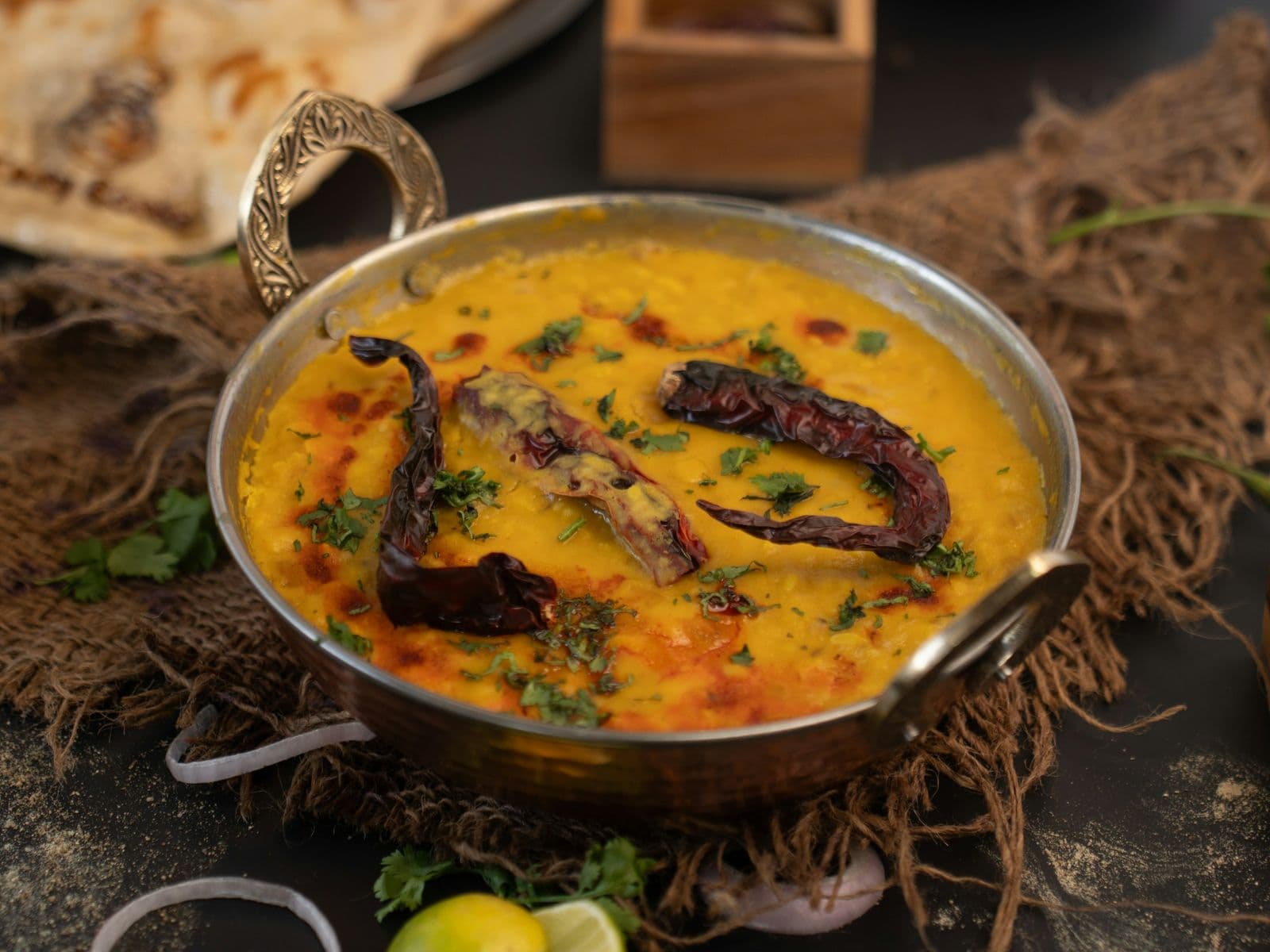
153calories
Protein
8.0 g
Carbs
23.2 g
Fat
3.5 g
1 cup = a 240 ml US cup of the dish as served. UK, Canadian and Australian cups are 250 ml: add about 4%.
Founding 500
Your bowl is not exactly 150 g.
Katori is an iPhone app that counts your actual plate from one photo. Built for Indian food first.
No spam. One email at launch, then only if it matters. Privacy.
First 500 sign-ups get the badge, paid or free. 10% off Pro annual, expires 30 days after launch, replaces the trial.
About toor dal
Toor dal is split pigeon pea, the everyday yellow dal of many Indian kitchens. It is sold as arhar dal, tur dal and tuvar dal too, all the same pulse. Our katori starts from 37 g of dry dal, the same dry weight as every dal on this site, cooked in water to 150 g and finished with 3 g of ghee and a little cumin, turmeric and ginger. USDA lists one raw record for pigeon peas, the whole mature seed, so split and skinned toor dal is modelled the same: per 100 g of dry dal it gives 343 calories, 21.7 g of protein and 15 g of fibre. Cooked, the dal itself comes to 127 calories a katori, and the home tadka adds 26. Toor is also the dal inside sambar and in much home dal tadka, which is why its numbers turn up on more plates than its name suggests.
Home vs takeout
The tadka decides the number. Each teaspoon of ghee, about 5 g, adds about 44 calories, while the 37 g of dal is the same in every row below. The plain row is the dal itself; the other two differ only in ghee.
| Version | 1 katori | 1 cup | Protein, 1 cup |
|---|---|---|---|
| Plain dal, no tadkaThe dal cooked in water, nothing added. | 127 | 203 | 12.8 g |
| Toor dal (light tadka)HeadlineThe everyday home version. | 153 | 245 | 12.9 g |
| Richer tadkaA restaurant style tempering with 8 g of ghee. | 197 | 315 | 12.9 g |
The everyday dal
Toor is the dal in sambar, in Maharashtrian varan and in much home dal tadka. Our sambar uses 18 g of dry toor dal a katori with vegetables and tamarind and comes to 109 calories, lighter than toor dal on its own because the vegetables and the tamarind water take up much of the bowl. Our dal tadka uses 37 g of dry toor, as this page does, with onion, tomato and a heavier ghee tadka, and comes to 181.
Plain, toor dal is 127 calories a katori. With the home tadka it is 153, and with a restaurant tadka 197. The 26 calories between the first two are the ghee, all of it, since the dal does not change from row to row.
Next to the other everyday dals, toor sits close to moong and below masoor. Moong dal is 155 calories and 8.8 g of protein a katori, masoor dal 176 calories and 9.1 g, and toor dal 153 calories and 8 g.
Part of masoor's higher figure is its recipe: our masoor katori carries onion, tomato and more ghee. Built the same way the gap would be smaller, so compare dals by their recipes, not only their names.
Thin, medium or thick: why one katori of dal varies
How thick you cook dal changes a katori more than most people expect. The table holds our home toor dal at three thicknesses, with the same tadka each time and water bringing every katori to 150 g. Our headline is the medium katori, 37 g of dry dal. A thin dal of 28 g comes to 122 calories and 6.1 g of protein, and a thick one of 46 g to 184 calories and 10 g, because the same bowl holds more lentils and less water.
To find your own row, weigh the dry dal before it goes into the pot, divide it by the number of katoris you serve, and read the closest line.
| One katori | Calories | Protein |
|---|---|---|
| Thin, 28 g of dry dal | 122 | 6.1 g |
| Medium, 37 g of dry dal, our headline | 153 | 8.0 g |
| Thick, 46 g of dry dal | 184 | 10.0 g |
Toor dal with rice or roti
Dry toor, cooked toor and the katori
| Per 100 g | Calories | Protein |
|---|---|---|
| Dry, from the packet (dry toor) | 343 | 21.7 g |
| As served, with water and tadka | 102 | 5.4 g |
| Dry against served | 3.4 times | |
| Katoris from 100 g of dry dal | 2.7 |
Cooking adds water, which adds weight but no calories, so check which figure a label or an app means before you log it.
Is toor dal healthy?
Of the calories from its protein, carbohydrate and fat, 59 percent come from carbohydrate, 21 percent from protein and 20 percent from fat, most of that fat being the tadka. The fibre is the dal's own.
What trials of pulses found
These findings are for pulses as a group, not for toor dal alone. A katori of toor dal here is 153 calories, with 8.0 g of protein and 5.6 g of fibre.
- Weight: a meta-analysis of 21 randomised trials found that diets including pulses, a median of about 132 g a day or roughly one serving, gave a weight reduction of 0.34 kg over a median of six weeks against diets without them, a modest effect.[4]
- Fullness: a review of feeding trials found that pulse meals gave 31 percent greater short-term satiety than meals with the same calories, but did not reduce what people ate at the next meal.[5]
- Blood sugar: a meta-analysis of 41 trials found that pulses, alone or in low glycaemic index or high-fibre diets, improved markers of longer-term glycaemic control, with high heterogeneity between studies.[6]
- Glycaemic index: the 2021 international tables found that legumes were usually low GI, 55 or under.[7] We do not quote a figure for any single dal.
If you manage your weight or your blood sugar for a medical reason, ask your doctor or a registered dietitian how dal fits your plan.
Toor dal vs related dishes
| Dish | 1 katori | 1 cup | Protein, 1 katori |
|---|---|---|---|
| Toor dal | 153 | 245 | 8.0 g |
| Moong dal | 155 | 247 | 8.8 g |
| Masoor dal | 176 | 281 | 9.1 g |
| Dal tadka | 181 | 289 | 8.4 g |
| Sambar | 109 | 175 | 4.5 g |
How we calculated this
Every number on this page is for 1 katori (150 g), worked out from the recipe below. Cup and 100 g figures are scaled from it.
- Toor dal (dry)37 g
- Ghee3 g
- Cumin, turmeric, gingertrace
- Water110 g
One katori of home toor dal from 37 g of dry dal, with a light tempering.
Ingredient values from USDA FoodData Central. The USDA record is the whole mature pigeon pea seed; split, skinned toor dal is modelled the same.
Confidence: high
Sources
- USDA FoodData Central 172436: Pigeon peas (red gram), mature seeds, raw
- USDA FoodData Central 173412: Butter oil, anhydrous
- USDA FoodData Central 170923: Spices, cumin seed
- Kim SJ et al. Effects of dietary pulse consumption on body weight: a systematic review and meta-analysis of randomized controlled trials. Am J Clin Nutr, 2016.
- Li SS et al. Dietary pulses, satiety and food intake: a systematic review and meta-analysis of acute feeding trials. Obesity, 2014.
- Sievenpiper JL et al. Effect of non-oil-seed pulses on glycaemic control: a systematic review and meta-analysis of randomised controlled experimental trials in people with and without diabetes. Diabetologia, 2009.
- Atkinson FS, Brand-Miller JC, Foster-Powell K, Buyken AE, Goletzke J. International tables of glycemic index and glycemic load values 2021: a systematic review. Am J Clin Nutr, 2021.
Common questions
How many calories are in 1 katori of toor dal?
About 153 calories for a katori of 150 g with a light ghee tadka. Plain, with no tadka, it is 127, and with a restaurant style tadka 197. A cup of 240 g is about 245.
How much protein is in toor dal?
About 8 g a katori, from 37 g of dry dal. USDA lists 21.7 g of protein per 100 g of dry pigeon peas.
Is toor dal protein or carbs?
Both, with carbohydrate first. Of the calories from its protein, carbohydrate and fat, 59 percent come from carbohydrate, 21 percent from protein and 20 percent from fat.
Can I eat toor dal during weight loss?
Yes, as part of a balanced plan. A katori is 153 calories with 8 g of protein and 5.6 g of fibre; see the research summary on this page. Keep the tadka light: plain toor dal is 127 calories a katori.
Is toor dal the same as arhar dal?
Yes. Toor, tur, tuvar and arhar are names for the same split pigeon pea, and the numbers on this page apply to all of them.
How many calories are in plain dal without tadka?
About 127 calories in a katori of plain toor dal: 37 g of dry dal cooked in water. The home tadka adds 26 calories, and the restaurant tadka 70.
Does toor dal spike blood sugar?
A katori of toor dal is 153 calories, with 23.2 g of carbohydrate and 5.6 g of fibre. See the research summary on this page.
Which dal is high in calories?
Of the dals we have built from a recipe, dal makhani is the highest, at 213 calories a katori and 142 per 100 g. Toor dal is the lowest, at 153 a katori and 102 per 100 g. For protein rather than calories, see which dal has the most protein. We only rank dals we have built from a recipe.
These figures are estimates from stated recipes, for general information. They are not medical or dietary advice. If you manage a health condition, check with a registered dietitian or your doctor.
Related dishes
Founding 500
Be one of the original 500.
Permanent badge, plus 10% off your first year of Pro.
Snap one photo and get these numbers for your actual plate, not a generic entry. Built for Indian food first.
No spam. One email at launch, then only if it matters. Privacy.
First 500 sign-ups get the badge, paid or free. 10% off Pro annual, expires 30 days after launch, replaces the trial.