Butter chicken calories: cup/katori and 100 g
Also called murgh makhani, chicken makhani and butter murgh.
By Shivam Verma Updated 10 sources linked below
One katori (150 g) of restaurant butter chicken has about 307 calories, 16.2 g of protein and 24.1 g of fat. One cup (240 g) has about 491. Made at home with half the butter and less cream it is 231 a katori, and a dhaba katori, heavy on both, reaches 360.
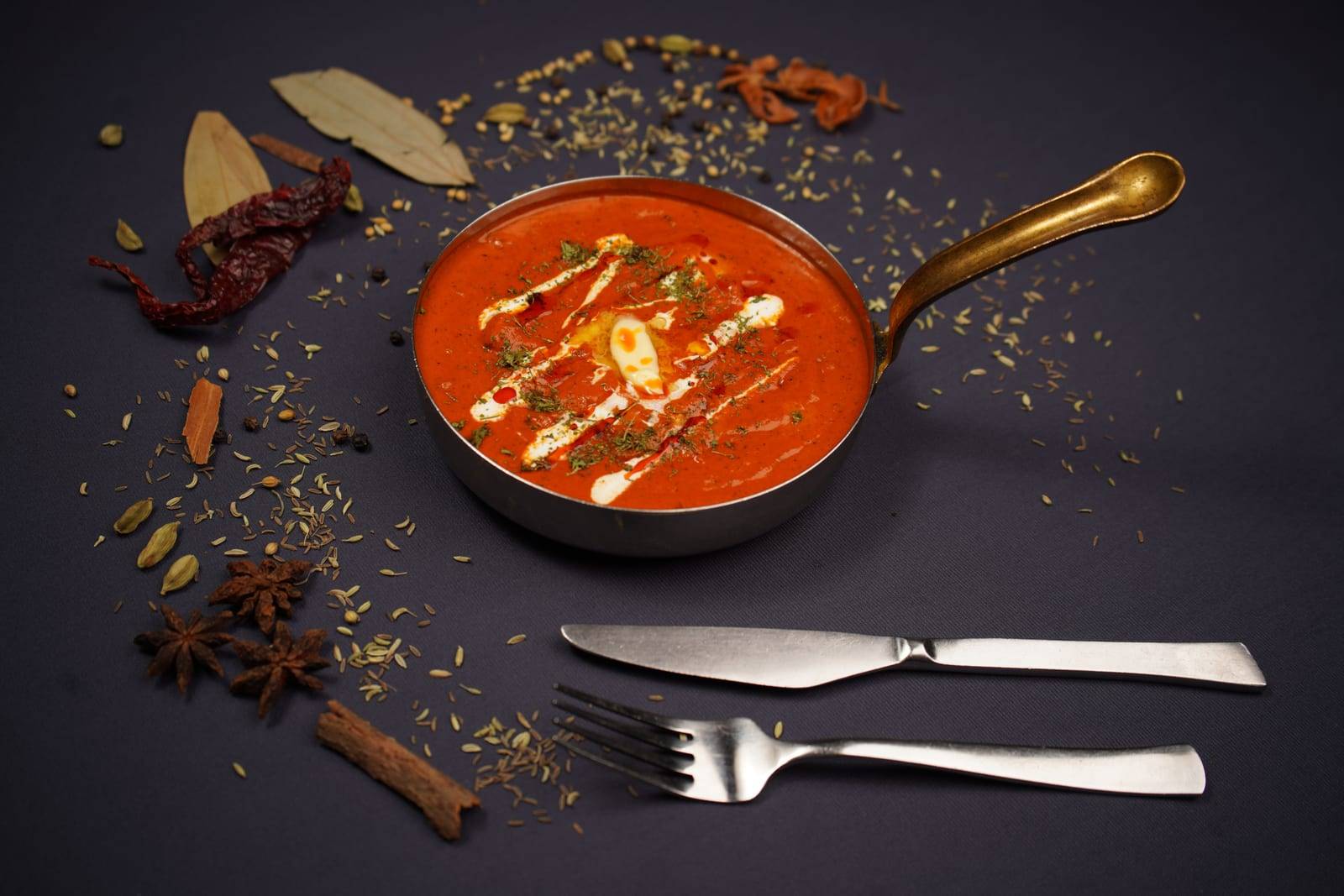
307calories
Protein
16.2 g
Carbs
7.4 g
Fat
24.1 g
1 cup = a 240 ml US cup of the dish as served. UK, Canadian and Australian cups are 250 ml: add about 4%.
Founding 500
Your bowl is not exactly 150 g.
Katori is an iPhone app that counts your actual plate from one photo. Built for Indian food first.
No spam. One email at launch, then only if it matters. Privacy.
First 500 sign-ups get the badge, paid or free. 10% off Pro annual, expires 30 days after launch, replaces the trial.
About butter chicken
Butter chicken is marinated chicken, usually thigh, finished in makhani gravy: tomato cooked down with butter, cream and a spoon of cashew paste, with kasuri methi crumbled in at the end. Our restaurant katori holds 70 g of raw thigh meat, 45 g of tomato puree, 12 g of butter, 20 g of cream and 5 g of cashews. The chicken brings 28 percent of the calories and nearly all of the 16.2 g of protein. Butter and cream together bring 44 percent, which is why two katoris that look the same on the plate can sit 129 calories apart.
Home vs takeout
The three katoris change the finish more than the chicken. Home uses 75 g of thigh with 6 g of butter and 8 g of cream; the restaurant katori 70 g with 12 g and 20 g; the dhaba katori 65 g with 18 g and 25 g.
| Version | 1 katori | 1 cup | Protein, 1 cup |
|---|---|---|---|
| Home, less butter and creamHalf the butter, less cream, a little more chicken. | 231 | 370 | 26.5 g |
| RestaurantHeadline | 307 | 491 | 25.8 g |
| Dhaba, extra butter and creamMore butter and cream, a little less chicken and tomato. | 360 | 576 | 24.7 g |
Butter and cream decide it
In the restaurant katori, 28 percent of the calories come from the butter, 16 percent from the cream and 9 percent from the cashews. That is about 86 calories of butter and 49 of cream. The chicken brings 28 percent, and the tomato puree, curd, oil and sugar the last 19.
The home katori halves the butter and cuts the cream to 8 g, and lands at 231 calories, 76 fewer than the restaurant one, with a little more chicken in it. The dhaba katori goes the other way: 18 g of butter alone is about 129 calories, and the katori comes to 360, 53 more than the restaurant one.
So when a menu or an app gives one figure for butter chicken, it is really telling you how much butter and cream it assumed. The chicken barely moves between the three katoris; the finish moves the number.
Chicken is 70 g of this katori, weighed raw, and brings 28 percent of its calories. Every chicken weight on this page is meat only, with no bone or skin, so a bone-in serving of the same weight holds less meat than these figures.
A study that measured US restaurant meals in the lab found they averaged 1,205 calories, and 92 percent of them exceeded typical energy needs for a single eating occasion. Why the restaurant version of a dish runs richer than the home one is set out dish by dish on the homemade vs restaurant page.
Thigh, not breast
Butter chicken is usually made with thigh, which stays soft in a long simmer. Raw thigh carries 4.1 g of fat and 19.7 g of protein per 100 g, against 2.6 g and 22.5 g for raw breast.
USDA weighs the meat of one raw, skinless thigh at 149 g, so the 70 g in our restaurant katori is a little under half a thigh. The dhaba katori, with less chicken and more butter, has 15.4 g of protein against 16.2 g in the restaurant one.
Swap the thigh in our restaurant katori for the same weight of breast and the katori comes to 306 calories, 18.1 g of protein and 23.0 g of fat. The cut matters less than the butter: the gravy is where the fat is.
Chicken loses water as it cooks. USDA's breast records carry 22.5 g of protein per 100 g raw and 31.0 g roasted, which implies that 100 g of raw breast roasts down to about 73 g, a loss of 27 percent. This recipe's water lost line is 18 g against 70 g of raw chicken, 26 percent, which also carries what simmers off the gravy.
The sauce on its own
Take the chicken out and the makhani gravy still carries 222 calories of the katori's 307, 72 percent, and 21.2 g of its 24.1 g of fat, 88 percent. That is the part of the katori that mopping up with naan adds back to the plate.
| Plate | Calories | Protein |
|---|---|---|
| 1 katori of butter chicken | 307 | 16.2 g |
| With 2 plain rotis | 511 | 24.1 g |
| With 1 plain naan | 565 | 23.1 g |
| With 1 katori of rice | 463 | 19.4 g |
Roti, naan and rice are each read from their own page.
Butter chicken and its neighbours
Chicken tikka masala is the closest dish on the menu: grilled breast tikka in an onion and tomato masala, finished with less butter. Our restaurant katori of it is 241 calories with 17.3 g of protein and 16.1 g of fat, against 307, 16.2 g and 24.1 g for butter chicken.
Paneer butter masala is the same gravy around paneer, and it is heavier: 368 calories a katori with 14.4 g of protein. Per 100 calories, butter chicken carries 5.3 g of protein against 3.9 g for the paneer version, because chicken thigh is leaner than paneer. A restaurant chicken korma is 281 calories, and a home chicken curry 170.
Ordering it lighter
The gap between our restaurant and home katoris is mostly 6 g of butter and 12 g of cream. Gram for gram, butter is the one to watch: every 5 g of it is about 36 calories, against 12 for 5 g of cream, because cream is mostly water.
Portion matters as much as the finish. If your serving fills two katoris, two katoris of our restaurant butter chicken come to 614 calories before any bread. With a plain naan the plate is 871, and with a butter naan 914.
Cooking for a family, our home recipe scales to a pot of 4 katoris: 300 g of raw thigh, 200 g of tomato puree, 24 g of butter, 32 g of cream and 12 g of cashews, about 925 calories in the pot. Use the restaurant's butter instead and the pot comes to 1097.
In a home katori the calories come from these lines: the 75 g of thigh about 91, the 50 g of tomato puree about 19, the butter about 43, the cream about 20, the cashews about 17 and the oil about 35. Cooking it yourself, the butter and the oil are the two lines worth weighing.
Is butter chicken healthy?
The saturated fat follows the butter and cream: 11.9 g in a restaurant katori, 6.4 g at home and 16.0 g at a dhaba. In the restaurant katori the butter brings 6.2 g of it, the cream 3.9 g and the chicken 0.8 g.
The smaller lines do their own jobs. The 5 g of cashew paste, about 28 calories and 0.9 g of protein, thickens the gravy without flour. The 45 g of tomato puree, about 17 calories, carries 4.0 g of the katori's carbohydrate and the sourness the butter and cream round off.
One katori of butter chicken carries 16.2 g of protein and 24.1 g of fat, 11.9 g of it saturated: 5.3 g of protein for every 100 calories. The ghee page sets the NHS and American Heart Association limits for saturated fat side by side.
| Dish | Serving | Calories | Protein | Fat | Chicken, raw |
|---|---|---|---|---|---|
| Chicken curry | 1 katori (150 g) | 170 | 14.7 g | 10.3 g | 70 g |
| Butter chicken | 1 katori (150 g) | 231 | 16.5 g | 15.5 g | 75 g |
| Chicken tikka masala | 1 katori (150 g) | 178 | 18.3 g | 8.6 g | 75 g |
| Chicken korma | 1 katori (150 g) | 211 | 16.3 g | 13.7 g | 70 g |
| Chicken tikka | 1 plate (6 pieces, 141 g) | 233 | 35.3 g | 7.9 g | 150 g |
| Tandoori chicken | 1 leg (138 g) | 222 | 31.4 g | 9.4 g | 160 g |
Each dish as cooked at home, from its stated recipe. Chicken is meat only, weighed raw.
Butter chicken vs related dishes
| Dish | 1 katori | 1 cup | Protein, 1 katori |
|---|---|---|---|
| Butter chicken | 231 | 370 | 16.5 g |
| Chicken tikka masala | 178 | 284 | 18.3 g |
| Chicken korma | 211 | 338 | 16.3 g |
| Chicken curry | 170 | 272 | 14.7 g |
| Paneer butter masala | 313 | 501 | 13.8 g |
| Dal makhani | 162 | 260 | 7.4 g |
Every row is home cooking, the version every dish has, so the rows compare like with like. Restaurant and dhaba figures are on each dish page and in the calculator.
Related guide: Homemade vs Restaurant Indian Food: Calorie Gap
How we calculated this
Every number on this page is for 1 katori (150 g), worked out from the recipe below. Cup and 100 g figures are scaled from it.
Correction, October 22, 2026: rebuilt from a stated recipe using USDA FoodData Central values, with the chicken weighed raw and meat only. One katori (150 g) of butter chicken was 320 calories; it is now 307.
- Chicken thigh, raw, meat only70 g
- Curd, for the marinade5 g
- Tomato puree45 g
- Butter12 g
- Cream20 g
- Cashews, ground to a paste5 g
- Cooking oil4 g
- Sugar1 g
- Water6 g
- Ginger, garlic, spices and kasuri methitrace
- Water lost from the chicken and the simmering gravy18 g lost
Restaurant style. Chicken is thigh meat, weighed raw with no bone or skin; cashews are weighed raw, before they are ground.
Ingredient values from USDA FoodData Central (SR Legacy). USDA has no survey record for butter chicken to cross-check against.
Confidence: high
Sources
- USDA FoodData Central 173627: Chicken, broilers or fryers, dark meat, thigh, meat only, raw
- USDA FoodData Central 171284: Yogurt, plain, whole milk
- USDA FoodData Central 170460: Tomato products, canned, puree, without salt added
- USDA FoodData Central 173410: Butter, salted
- USDA FoodData Central 170858: Cream, fluid, light whipping
- USDA FoodData Central 170162: Nuts, cashew nuts, raw
- USDA FoodData Central 171411: Oil, soybean, salad or cooking
- USDA FoodData Central 169655: Sugars, granulated
- USDA FoodData Central 170923: Spices, cumin seed
- Urban LE et al. Energy contents of frequently ordered restaurant meals and comparison with human energy requirements and U.S. Department of Agriculture database information: a multisite randomized study. J Acad Nutr Diet, 2016.
Common questions
How many calories are in 1 katori of butter chicken?
About 307 for a restaurant katori of 150 g. Home style it is 231, or 370 a cup, and a dhaba katori 360.
Is butter chicken okay for weight loss?
A restaurant katori is 307 calories with 16.2 g of protein and 24.1 g of fat; made at home it is 231 with 16.5 g of protein. The butter and cream are where the difference sits.
How many calories are in takeout butter chicken?
A rich takeout or dhaba katori, with 18 g of butter and 25 g of cream, is about 360 calories with 30.4 g of fat. A takeout container can hold more than one katori, so count the container, not the dish.
How many calories are in homemade butter chicken?
About 231 a katori in our home recipe: 75 g of thigh, 6 g of butter and 8 g of cream, with 15.5 g of fat.
Is butter chicken sauce unhealthy?
The sauce carries most of the fat: 21.2 g of the restaurant katori's 24.1 g, and 72 percent of its calories, mostly from the butter and cream.
How much protein is in butter chicken?
About 16.2 g in a restaurant katori, almost all of it from the 70 g of thigh meat, and 16.5 g in a home katori with a little more chicken.
Is chicken korma healthier than butter chicken?
By our recipes a restaurant katori of chicken korma is 281 calories with 21.4 g of fat, against 307 calories and 24.1 g for butter chicken. Both get most of their richness from cream and fat rather than from the chicken.
Is butter chicken the same as chicken tikka masala?
No. Butter chicken is usually thigh in a butter and tomato makhani gravy; tikka masala is grilled breast tikka in an onion and tomato masala. Our restaurant katoris are 307 and 241 calories.
These figures are estimates from stated recipes, for general information. They are not medical or dietary advice. If you manage a health condition, check with a registered dietitian or your doctor.
Related dishes
Founding 500
Be one of the original 500.
Permanent badge, plus 10% off your first year of Pro.
Snap one photo and get these numbers for your actual plate, not a generic entry. Built for Indian food first.
No spam. One email at launch, then only if it matters. Privacy.
First 500 sign-ups get the badge, paid or free. 10% off Pro annual, expires 30 days after launch, replaces the trial.