Rice calories: cup/katori and 100 g
Also called white rice, cooked rice, chawal, steamed rice and boiled rice.
By Shivam Verma Updated 7 sources linked below
One katori of cooked white rice, 120 g as served, has about 156 calories, 3.2 g of protein and 0.3 g of fat. One cup (158 g, USDA's weight for cooked long-grain rice) has about 205, and 100 g has 130. A level katori holds about 99 g, 129 calories; a heaped one, 150 g, 195.
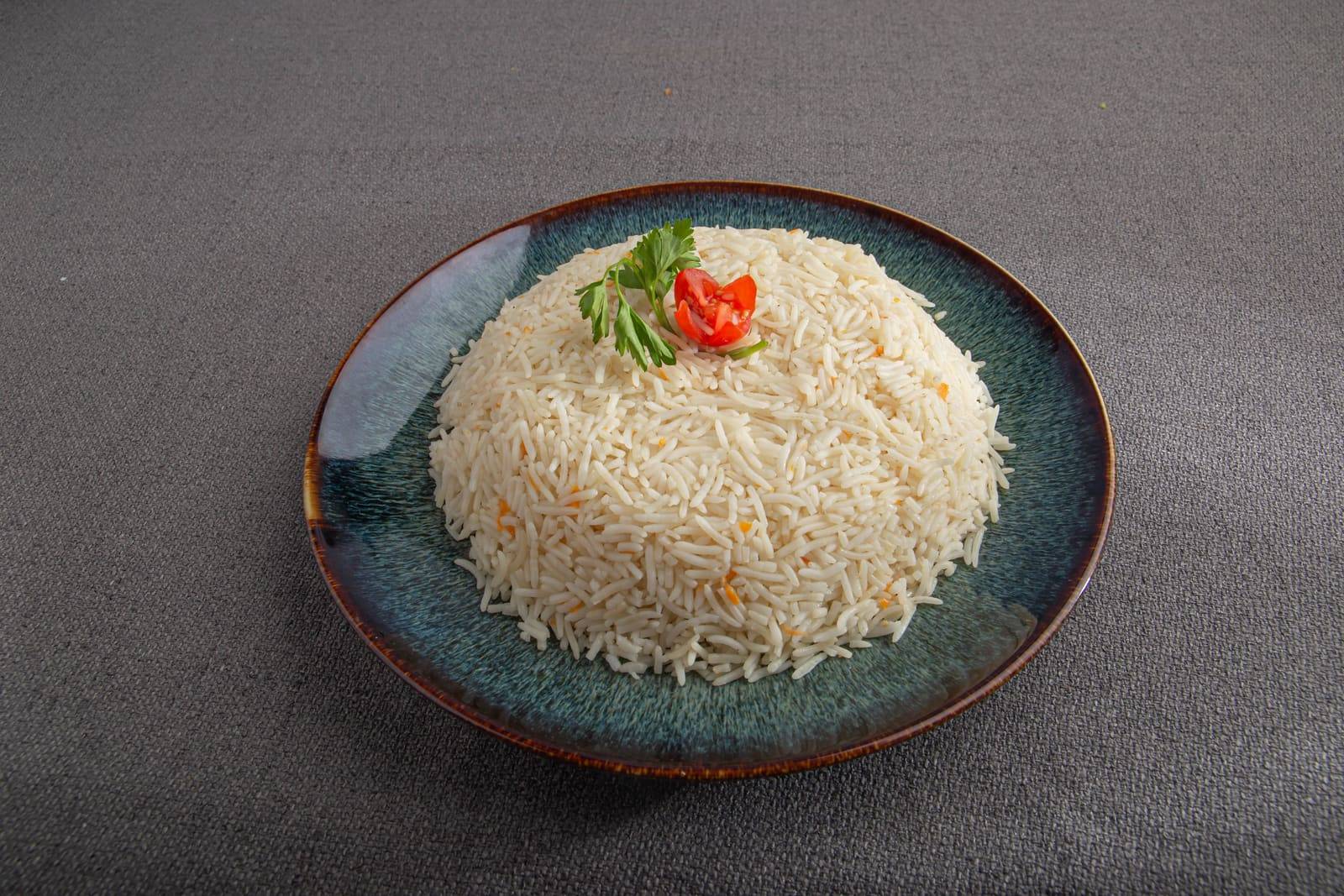
156calories
Protein
3.2 g
Carbs
33.8 g
Fat
0.3 g
1 cup = a 240 ml US cup of the dish as served. UK, Canadian and Australian cups are 250 ml: add about 4%.
Founding 500
Your bowl is not exactly 120 g.
Katori is an iPhone app that counts your actual plate from one photo. Built for Indian food first.
No spam. One email at launch, then only if it matters. Privacy.
First 500 sign-ups get the badge, paid or free. 10% off Pro annual, expires 30 days after launch, replaces the trial.
About rice
Plain rice is the simplest number on this site and still one of the most misread. Boiling rice soaks up about 1.8 times its own weight in water, so the same grains that carry 365 calories per 100 g dry carry 130 per 100 g cooked. A katori of cooked rice holds the energy of about 43 g of dry rice. Rice is also the one food here counted from a cooked USDA record rather than built from raw ingredients, because USDA's cooked long-grain record is exactly what lands in the katori: white rice boiled in water, nothing added. Almost all of it is carbohydrate, with 33.8 g in a katori, a little protein and barely any fat, so the calories follow the weight on the spoon and almost nothing else. That is why the portion matters more here than on any curry page: the difference between a level katori and a heaped one is bigger than the difference between white rice and brown.
Home vs takeout
Plain rice has no restaurant version: a kitchen boils it the way you do, so the rows below are the rice itself. White and brown are each a 120 g katori; the third row is the white katori with a teaspoon of ghee, 4.3 g, stirred through it.
| Version | 1 katori | 1 cup | Protein, 1 cup |
|---|---|---|---|
| White rice, plainHeadlineBoiled long-grain rice, nothing added. | 156 | 205 | 4.3 g |
| Brown rice, plainBoiled long-grain brown rice: more fibre, slightly fewer calories by weight. | 148 | 194 | 4.3 g |
| White rice with 1 teaspoon of gheeThe same katori with ghee stirred through it. | 194 | 246 | 4.1 g |
Raw vs cooked rice
Dry rice and cooked rice are the same grains at very different weights. Per 100 g, raw long-grain rice is 365 calories and cooked is 130, because the cooked figure is mostly water. Weigh rice dry and count it on the raw line; weigh it cooked and count it on the cooked one. Mixing the two is the commonest rice mistake in a food diary.
| Per 100 g | Calories | Protein |
|---|---|---|
| White rice, raw | 365 | 7.1 g |
| White rice, cooked | 130 | 2.7 g |
| Brown rice, cooked | 123 | 2.7 g |
Level, heaped and served
A level 150 ml katori of cooked long-grain rice, the basmati type, weighs about 99 g by USDA's figure of 158 g per cup, and medium-grain rice such as sona masoori is closer to 116 g. This site counts a katori of rice as 120 g, a little above level: our stated assumption.
In calories, the level katori of long-grain rice is 129, the served katori 156 and a heaped katori of 150 g 195. Medium-grain rice packs tighter: a level katori of sona masoori type rice is about 116 g, and since USDA's medium-grain record is also 130 calories per 100 g, that bowl is 151. Same bowl, same calories per gram, and the grain shape alone moves it by 22 calories.[5]
USDA's own survey of what Americans eat assigns 118 g to a serving of white rice when nobody says how much, about 152 calories, which lands close to our served katori. Two katoris, a common second helping, come to 312 calories and 6.5 g of protein.[6]
White against brown rice
By the katori, brown rice is a little lighter: 148 calories against 156 for white, 8 fewer. It carries 1.9 g of fibre to white rice's 0.5 g and 1.2 g of fat to 0.3 g, because the bran layer stays on the grain. Protein is close, 3.3 g against 3.2 g.
By the cup the order flips. USDA weighs a cup of cooked brown long-grain rice at 202 g and a cup of white at 158 g, so a cup of brown rice is about 248 calories against 205 for white. Brown grains stay separate and dense, and more of them fit in the cup. Per 100 g, brown is 123 and white 130, so on a scale brown wins by a small margin; in a measuring cup it loses.
A teaspoon of ghee on top
A teaspoon of ghee, 4.3 g, stirred into a katori of hot rice adds about 38 calories and takes the bowl to 194. Fat rises from 0.3 g to 4.6 g, and saturated fat from 0.1 g to 2.8 g, almost all of it the ghee's. Nothing else on the plate changes: the rice brings the same carbohydrate either way.
This is where rice calories usually grow. The rice is fixed by weight; the ghee, the dal tadka poured over it and the second spoon of curry are what make one katori of rice into a much bigger meal.
Boiled rice from a takeaway
safefood's laboratory analysis of Indian takeaways in Ireland and Northern Ireland measured the average portion of plain boiled rice at 284 g and 387 calories. That portion is about 2.4 of our katoris. USDA's cooked rice at the same weight comes to 369 calories, 5 percent under the laboratory figure, which is close for two different measurements of plain rice.[7]
USDA's survey record for white rice cooked with no fat added is 129 calories per 100 g, against 130 for the long-grain record we use. The rice is the same food on both sides of the counter; the takeaway portion is just bigger than a katori.[6]
Is rice healthy?
On its own numbers, a katori of white rice is a modest, almost fat-free serving of carbohydrate with little fibre and a little protein: 2.1 g of protein for every 100 calories. What it does to a meal depends on what goes with it. Paired with a katori of dal it becomes the everyday dal chawal plate; doused in ghee or a cream gravy it carries their fat. The table below sets plain rice beside jeera rice and veg pulao, the two rice dishes that add fat in the pan.
One katori of rice carries 3.2 g of protein and 0.3 g of fat, 0.1 g of it saturated: 2.1 g of protein for every 100 calories. The ghee page sets the NHS and American Heart Association limits for saturated fat side by side.
| Dish | 1 katori | 1 cup | 100 g | Protein, 100 g | Fat, 100 g |
|---|---|---|---|---|---|
| Rice | 156 | 205 | 130 | 2.7 g | 0.3 g |
| Jeera rice | 181 | 238 | 151 | 2.8 g | 2.9 g |
| Veg pulao | 167 | 219 | 139 | 2.6 g | 3.6 g |
Calories for each as cooked at home. A katori of rice is counted at its served weight and a cup at USDA's 158 g for cooked long-grain rice, the same for all three.
Rice vs related dishes
| Dish | 1 katori | 1 cup | Protein, 1 katori |
|---|---|---|---|
| Rice | 156 | 205 | 3.2 g |
| Jeera rice | 181 | 238 | 3.3 g |
| Veg pulao | 167 | 219 | 3.1 g |
| Dal tadka | 181 | 289 | 8.4 g |
Every row is home cooking, the version every dish has, so the rows compare like with like. Restaurant and dhaba figures are on each dish page and in the calculator.
Related guide: Roti vs Rice: Which Is Better for Weight Loss?
How we calculated this
Every number on this page is for 1 katori (120 g), worked out from the recipe below. Cup and 100 g figures are scaled from it.
Correction, September 2026: we previously listed one katori of rice as 150 g and 195 calories. Our own katori guide and USDA density data put a lightly packed 150 ml katori at about 120 g, so we corrected rice, jeera rice, and veg pulao to 120 g per katori.
- White rice, cooked120 g
One katori of plain white rice, weighed cooked: 120 g, a 150 ml katori filled a little above level. Rice is the one food on this site counted from a cooked USDA record, because that record is plain boiled rice, the food served.
USDA FoodData Central SR Legacy: cooked long-grain white rice, cooked brown rice and ghee, with raw and medium-grain rice and USDA's survey record for comparison.
Confidence: high
Sources
- USDA FoodData Central 168878: Rice, white, long-grain, regular, enriched, cooked
- USDA FoodData Central 169704: Rice, brown, long-grain, cooked (Includes foods for USDA's Food Distribution Program)
- USDA FoodData Central 173412: Butter oil, anhydrous
- USDA FoodData Central 168877: Rice, white, long-grain, regular, raw, enriched
- USDA FoodData Central 168880: Rice, white, medium-grain, enriched, cooked
- USDA FoodData Central 2708408: Rice, white, cooked, no added fat
- safefood. What's in your Indian takeaway? Laboratory analysis of 280 takeaway samples from 36 outlets, September 2015.
Common questions
How many calories in 1 katori of rice?
About 156 for a katori of plain cooked white rice, 120 g as it is usually served, with 3.2 g of protein and 33.8 g of carbohydrate. A level katori is nearer 129, and a heaped one 195.
How many calories in 1 cup of cooked rice?
About 205 for a US cup of cooked white long-grain rice, which USDA weighs at 158 g. A cup holds a little more than a served katori, which is why the cup figure is the larger one.
How many calories in 1 cup of cooked basmati rice?
About 205. USDA's main nutrient tables have no separate basmati record; basmati is a long-grain rice, so its cooked long-grain white rice is the closest match, at 130 calories per 100 g. Glycemic index tests and arsenic are in the basmati guide.
How many calories in 100 g of cooked rice?
130 for white rice and 123 for brown, with 2.7 g of protein in the white. Dry rice is 365 per 100 g, so always check which one a label means.
Why is a katori of rice 120 g and not 150 g?
Because a katori measures volume, not weight, and cooked grains trap air. A 150 ml katori filled level holds about 99 g of long-grain rice; served a little above level it is about 120 g. Dal or curd fill the same bowl at close to its full 150 g.
Is brown rice lower in calories than white rice?
Slightly, by weight: 148 against 156 for a katori. By the cup it is the other way round, 248 against 205, because a cup of brown rice weighs more. Brown rice's real difference is fibre.
Is rice or roti better for weight loss?
On calories, a katori of rice is 156 and two plain rotis are 204. Five hundred calories of plain rice is about 385 g, 3.2 katoris. What goes on the rice or the roti moves the total more than the choice between them.
How much dry rice makes one katori of cooked rice?
By calories, a 120 g katori of cooked rice holds the energy of about 43 g of dry rice, at 365 calories per 100 g dry. The rest of the weight is the water it absorbed.
These figures are estimates from stated recipes, for general information. They are not medical or dietary advice. If you manage a health condition, check with a registered dietitian or your doctor.
Related dishes
Founding 500
Be one of the original 500.
Permanent badge, plus 10% off your first year of Pro.
Snap one photo and get these numbers for your actual plate, not a generic entry. Built for Indian food first.
No spam. One email at launch, then only if it matters. Privacy.
First 500 sign-ups get the badge, paid or free. 10% off Pro annual, expires 30 days after launch, replaces the trial.