Dal tadka calories: cup/katori and 100 g
Also called tadka dal, tarka dal and toor dal tadka.
By Shivam Verma Updated 9 sources linked below
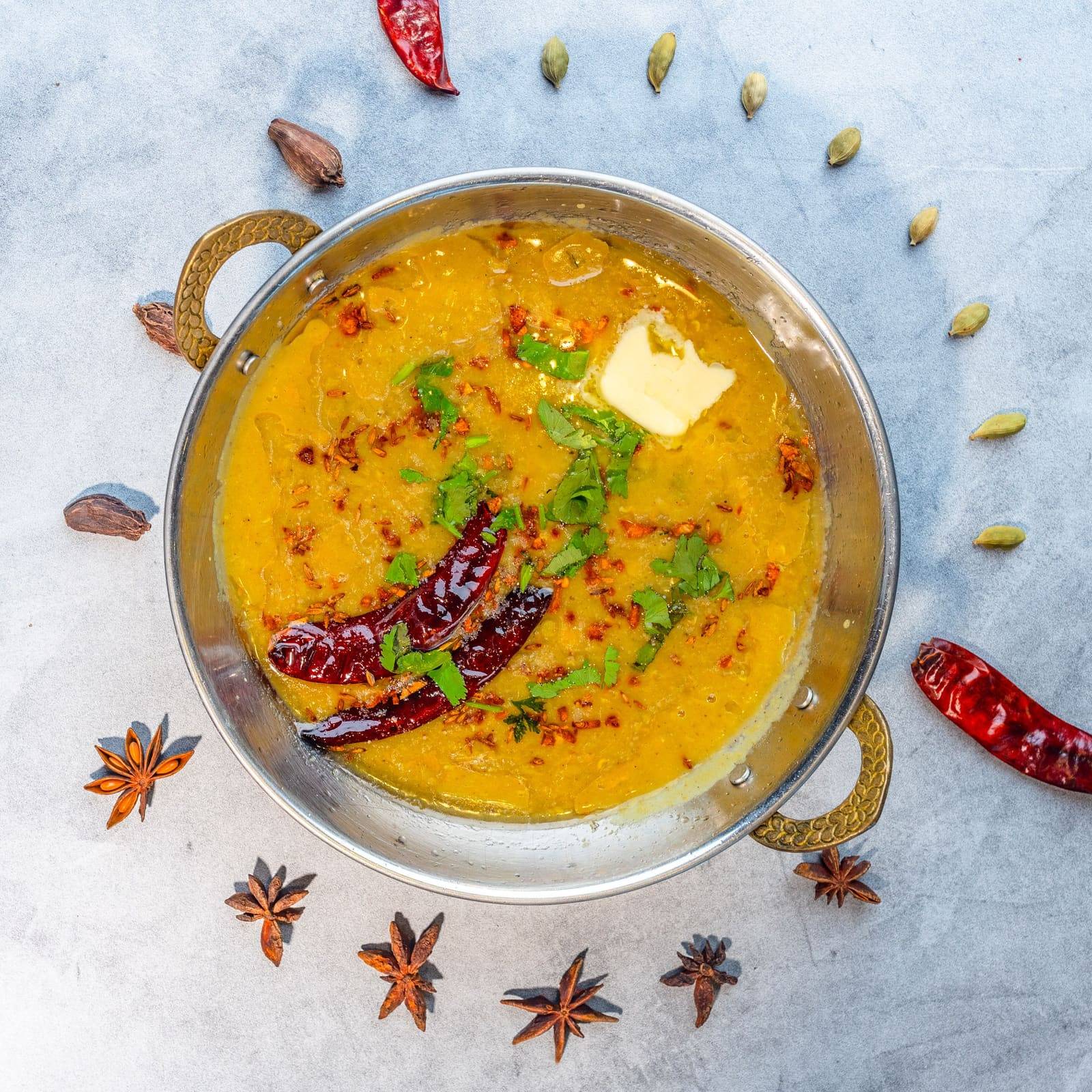
One katori (150 g) of home dal tadka has about 181 calories and 8.4 g protein. One cup (240 g) has about 289. Plain boiled toor dal is 127 a katori, and a restaurant tadka with more ghee takes it to 207.
181calories
Protein
8.4 g
Carbs
25.5 g
Fat
5.6 g
1 cup = a 240 ml US cup of the dish as served. UK, Canadian and Australian cups are 250 ml: add about 4%.
Founding 500
Your bowl is not exactly 150 g.
Katori is an iPhone app that counts your actual plate from one photo. Built for Indian food first.
No spam. One email at launch, then only if it matters. Privacy.
First 500 sign-ups get the badge, paid or free. 10% off Pro annual, expires 30 days after launch, replaces the trial.
About dal tadka
Dal tadka is the everyday dal of home kitchens and restaurant menus alike: toor dal, sometimes with a little moong, cooked soft and finished with a tempering of ghee, cumin, garlic and chilli, fried in a small pan and poured over at the end. On UK takeaway menus it is tarka dal. Our home katori is 37 g of dry toor dal, cooked, with onion, tomato and 5 g of ghee. Plain boiled toor dal is about 127 calories a katori, and the tadka is what lifts the number: the home tempering lands at 181, and a restaurant one with 8 g of ghee at about 207. The 5 g of ghee in a home tadka adds about 44 calories on its own. Count the ghee in the tadka rather than assuming the lentils tell the whole story.
Home vs takeout
The dal is the same 37 g of dry toor in every row; the tempering pan is what changes. One teaspoon of ghee, about 5 g, is 44 calories.
| Version | 1 katori | 1 cup | Protein, 1 cup |
|---|---|---|---|
| Boiled toor dal, no tadkaDry toor dal cooked in water, no tadka. | 127 | 203 | 12.8 g |
| Standard dal tadkaHeadlineThe everyday preparation. | 181 | 289 | 13.4 g |
| Restaurant, richer tadka8 g of ghee in the tadka, a richer finish. | 207 | 331 | 13.4 g |
| Tadka in oil instead of gheeThe home recipe with 5 g of soybean oil in place of the ghee. | 181 | 290 | 13.4 g |
Where the calories in a tadka sit
A home katori of dal tadka carries 5 g of ghee, and that ghee supplies 24 percent of its 181 calories. A restaurant katori carries 8 g, 34 percent of its 207.
Our calculator's dhaba setting adds 6 g of ghee to the restaurant katori, about 53 calories, which puts a dhaba katori near 260 calories with 14 g of ghee, 47 percent of its calories.
Plain, with no onion, tomato or ghee, the same toor, cooked in water, is 127 calories a katori. The gap between the home and restaurant katoris is 26 calories, the same as about 0.6 teaspoons of ghee, so the cheapest saving in dal tadka is a lighter pour from the tempering pan.
Onion and tomato add a little too, 10 calories a katori between them, and they are the part of the tadka worth keeping generous: they add flavour and volume for far fewer calories than the ghee.
Ghee or oil in the tadka
Make the home tadka with 5 g of soybean oil in place of the 5 g of ghee and the calories barely move: both katoris come to 181. Both are almost pure fat, so gram for gram they carry nearly the same energy.
What changes is the kind of fat. The ghee brings 3.1 g of saturated fat to the katori; the same weight of soybean oil brings 0.8 g, 2.3 g less. If saturated fat is what you watch, the oil tadka is the swap that counts. If calories are, how much fat goes into the pan matters far more than which fat it is. The ghee page sets ghee beside other cooking fats, spoon by spoon.
Dal tadka with rice or roti
The choice between rice and roti moves the plate less than the tadka does. Swapping the home tadka for a restaurant one adds 26 calories to either plate, and a second katori of rice adds 156.
Some cooks make dal tadka with a mix of toor and moong. Our moong dal katori, with a lighter ghee tadka and no onion or tomato, is 155 calories, so a mixed dal sits near the toor figure here when the tadka is the same, and lower when the tadka is lighter.
Is dal tadka healthy?
For its calories, dal tadka brings a fair amount: 8.4 g of protein and 6.1 g of fibre a katori, almost all of it from the toor dal, for 181 calories with a home tadka.
What trials of pulses found
These findings are for pulses as a group, not for dal tadka alone. A katori of dal tadka here is 181 calories, with 8.4 g of protein and 6.1 g of fibre.
- Weight: a meta-analysis of 21 randomised trials found that diets including pulses, a median of about 132 g a day or roughly one serving, gave a weight reduction of 0.34 kg over a median of six weeks against diets without them, a modest effect.[6]
- Fullness: a review of feeding trials found that pulse meals gave 31 percent greater short-term satiety than meals with the same calories, but did not reduce what people ate at the next meal.[7]
- Blood sugar: a meta-analysis of 41 trials found that pulses, alone or in low glycemic index or high-fibre diets, improved markers of longer-term glycemic control, with high heterogeneity between studies.[8]
- Glycemic index: the 2021 international tables found that legumes were usually low GI, 55 or under.[9] We do not quote a figure for any single dal.
If you manage your weight or your blood sugar for a medical reason, ask your doctor or a registered dietitian how dal fits your plan.
Dal tadka vs related dishes
| Dish | 1 katori | 1 cup | Protein, 1 katori |
|---|---|---|---|
| Dal tadka | 181 | 289 | 8.4 g |
| Toor dal | 153 | 245 | 8.0 g |
| Moong dal | 155 | 247 | 8.8 g |
| Masoor dal | 176 | 281 | 9.1 g |
| Dal makhani | 162 | 260 | 7.4 g |
Every row is home cooking, the version every dish has, so the rows compare like with like. Restaurant and dhaba figures are on each dish page and in the calculator.
Related guide: Lentil Protein: Which Dal Has the Most?
How we calculated this
Every number on this page is for 1 katori (150 g), worked out from the recipe below. Cup and 100 g figures are scaled from it.
Correction, October 21, 2026: rebuilt from dry dal weight instead of USDA's cooked dal record, so every dal on this site is counted the same way. One katori was 187 calories and 7.8 g protein; it is now 181 and 8.4 g.
Correction, October 14, 2026: one katori of dal tadka was listed at 180 calories and 9 g protein (120 calories per 100 g). It is now 187 calories and 7.8 g protein (125 calories per 100 g). Recomputed from the stated recipe using USDA FoodData Central values. The earlier figure did not match its own recipe.
- Toor dal (dry)37 g
- Ghee for tadka5 g
- Onion17.5 g
- Tomato17.5 g
- Garlic, cumin, chillitrace
- Water73 g
One katori of home dal tadka with a standard ghee tempering. A restaurant tadka uses more ghee.
Ingredient values from USDA FoodData Central. Cross referenced against IFCT 2017 (ICMR-NIN).
Confidence: high
Sources
- USDA FoodData Central 172436: Pigeon peas (red gram), mature seeds, raw
- USDA FoodData Central 173412: Butter oil, anhydrous
- USDA FoodData Central 170000: Onions, raw
- USDA FoodData Central 170457: Tomatoes, red, ripe, raw, year round average
- USDA FoodData Central 170923: Spices, cumin seed
- Kim SJ et al. Effects of dietary pulse consumption on body weight: a systematic review and meta-analysis of randomized controlled trials. Am J Clin Nutr, 2016.
- Li SS et al. Dietary pulses, satiety and food intake: a systematic review and meta-analysis of acute feeding trials. Obesity, 2014.
- Sievenpiper JL et al. Effect of non-oil-seed pulses on glycaemic control: a systematic review and meta-analysis of randomised controlled experimental trials in people with and without diabetes. Diabetologia, 2009.
- Atkinson FS, Brand-Miller JC, Foster-Powell K, Buyken AE, Goletzke J. International tables of glycemic index and glycemic load values 2021: a systematic review. Am J Clin Nutr, 2021.
Common questions
How many calories are in dal tadka?
About 181 calories in a home katori of 150 g. Plain boiled toor dal is 127, and a restaurant tadka 207. A cup of 240 g is about 289.
Is tarka dal the same as dal tadka?
Yes. Tarka dal is how the dish is often spelled on UK takeaway menus; tadka and tarka are the same tempering, and the numbers on this page apply to both. Dal fry is a related but different dish, so this page does not cover it.
How many calories are in a takeaway tarka dal?
Our restaurant katori, with 8 g of ghee in the tadka, is 207 calories. A takeaway tub can hold more than a katori, so weigh it if you can: every 100 g of restaurant style dal tadka is about 138 calories.
How much ghee is in dal tadka?
About 5 g in a home katori, 44 calories, and 8 g in a restaurant katori, 70 calories. A teaspoon of ghee is about 5 g.
Which dal is used in dal tadka?
Toor dal, sometimes mixed with a little moong dal. Our recipe uses toor dal alone. The toor dal page has the dal plain and with a lighter tadka, and the moong dal page has the lighter dal on its own.
How many calories are in dal tadka with rice?
About 337 calories for a katori of home dal tadka with a katori of rice, and 11.6 g of protein. With a restaurant tadka, add 26.
Does dal tadka spike blood sugar?
A katori of dal tadka is 181 calories with 6.1 g of fibre, and the rice or roti beside it matters as much as the dal. See the research summary on this page.
Can I make dal tadka with oil instead of ghee?
Yes. With 5 g of soybean oil in place of the ghee, a katori is 181 calories against 181, and the tadka brings 0.8 g of saturated fat instead of 3.1 g.
These figures are estimates from stated recipes, for general information. They are not medical or dietary advice. If you manage a health condition, check with a registered dietitian or your doctor.
Related dishes
Founding 500
Be one of the original 500.
Permanent badge, plus 10% off your first year of Pro.
Snap one photo and get these numbers for your actual plate, not a generic entry. Built for Indian food first.
No spam. One email at launch, then only if it matters. Privacy.
First 500 sign-ups get the badge, paid or free. 10% off Pro annual, expires 30 days after launch, replaces the trial.