Moong dal calories: cup/katori and 100 g
Also called mung dal, yellow moong dal, split mung beans, green gram dal and pesarapappu.
By Shivam Verma Updated 10 sources linked below
One katori (150 g) of moong dal with a light ghee tadka has about 155 calories and 8.8 g protein. One cup (240 g) has about 247. Plain boiled moong dal is lighter at 128 a katori, and a restaurant style tadka takes it to 198.
155calories
Protein
8.8 g
Carbs
23.2 g
Fat
3.4 g
1 cup = a 240 ml US cup of the dish as served. UK, Canadian and Australian cups are 250 ml: add about 4%.
Founding 500
Your bowl is not exactly 150 g.
Katori is an iPhone app that counts your actual plate from one photo. Built for Indian food first.
No spam. One email at launch, then only if it matters. Privacy.
First 500 sign-ups get the badge, paid or free. 10% off Pro annual, expires 30 days after launch, replaces the trial.
About moong dal
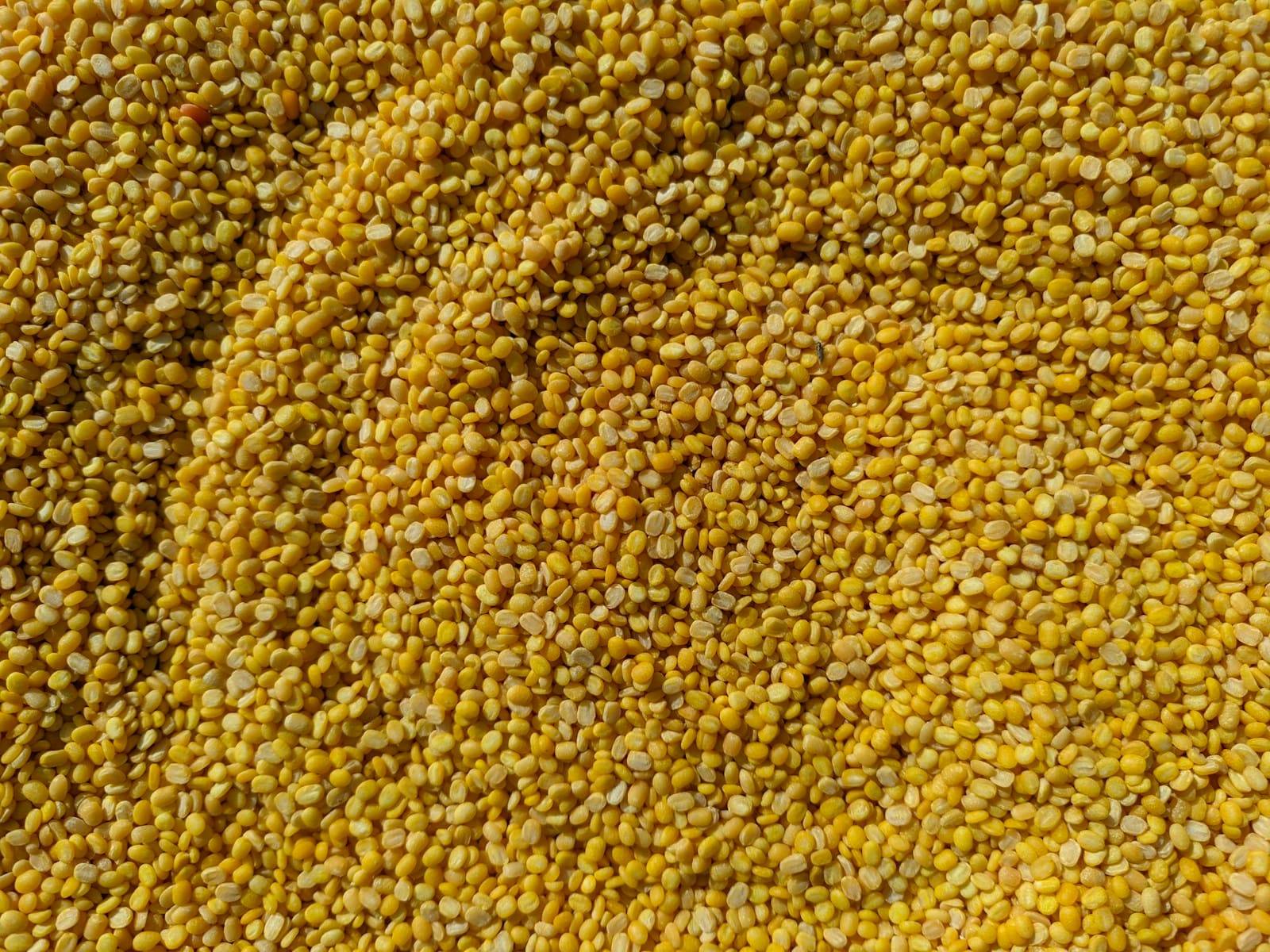
One katori of moong dal (150 g) has roughly 155 calories, with about 8.8 g protein, 23.2 g carbohydrate, 3.4 g fat and 6 g fibre. Built from 37 g of dry moong, like every dal on this site, it lands close to toor dal at 153. It stays light for two reasons: this recipe uses a light tadka, 3 g of ghee, and no onion and tomato base, and dry mung beans carry a few calories less than dry red lentils, 347 against 358 per 100 g. Plain boiled moong is 128 calories a katori. Most of the difference between versions is the ghee, which is why a restaurant moong dal with 8 g of ghee comes to 198. Moong dal is usually made with split, dehulled yellow moong; whole green moong is the same pulse with its hull on. For tracking, weigh your katori once, and count the tadka rather than assuming the dal tells the whole story.
Home vs takeout
The tadka decides the number. Each teaspoon of ghee, about 5 g, adds about 44 calories, while the dal itself does not change: the same 37 g of dry moong sits in every version below.
| Version | 1 katori | 1 cup | Protein, 1 cup |
|---|---|---|---|
| Plain boiled moongNo tempering, just turmeric and salt. | 128 | 205 | 14.1 g |
| Moong dal (light tadka)HeadlineThe standard preparation. | 155 | 247 | 14.1 g |
| Richer tadka8 g of ghee in the tempering, our restaurant style version. | 198 | 318 | 14.2 g |
Dry moong and cooked moong
| Per 100 g | Calories | Protein |
|---|---|---|
| Dry, from the packet (dry moong) | 347 | 23.9 g |
| As served, with water and tadka | 103 | 5.9 g |
| Dry against served | 3.4 times | |
| Katoris from 100 g of dry dal | 2.7 |
Cooking adds water, which adds weight but no calories, so check which figure a label or an app means before you log it.
Yellow moong vs whole green moong
Yellow moong dal is the split, dehulled bean. Whole green moong is the same pulse with its green hull on. USDA lists one raw record for mung beans, the whole mature seed, and that is the record every number on this page uses: there is no separate record for the split dal.
What changes with the hull is how fast the starch reaches your blood. A review of 48 studies found that the glycemic index of mung bean preparations ranged from 11 to 90 against glucose. Removing the hull, grinding, blending and pureeing all pushed it higher, and so did long, high-heat cooking, because each one exposes more starch to digestion.
So a smooth, well cooked yellow dal tends toward the faster end of that range, and whole green moong cooked until just tender tends toward the slower end. The same review found that the other foods in a meal change the response as well. For calories and protein, the split and whole forms are close enough that the choice is about the meal you want, not the number.[2][6]
Is moong dal good for weight loss?
The bigger lever on your plate is the tadka. A katori of plain boiled moong is 128 calories. The home version with 3 g of ghee is 155. A restaurant tadka with 8 g is 198. The dal is identical in all three, so every calorie of difference comes from the pan.
Practical swaps: temper with one teaspoon of ghee rather than two, add the tadka at the table so you can see how much goes in, and if you want a bigger meal, take a second katori of dal before a second katori of rice. The dal brings 8.8 g protein and 6 g fibre for its 155 calories.
What trials of pulses found
These findings are for pulses as a group, not for moong dal alone. A katori of moong dal here is 155 calories, with 8.8 g of protein and 6.0 g of fibre.
- Weight: a meta-analysis of 21 randomised trials found that diets including pulses, a median of about 132 g a day or roughly one serving, gave a weight reduction of 0.34 kg over a median of six weeks against diets without them, a modest effect.[4]
- Fullness: a review of feeding trials found that pulse meals gave 31 percent greater short-term satiety than meals with the same calories, but did not reduce what people ate at the next meal.[5]
- Blood sugar: a meta-analysis of 41 trials found that pulses, alone or in low glycemic index or high-fibre diets, improved markers of longer-term glycemic control, with high heterogeneity between studies.[9]
- Glycemic index: the 2021 international tables found that legumes were usually low GI, 55 or under.[10] We do not quote a figure for any single dal.
If you manage your weight or your blood sugar for a medical reason, ask your doctor or a registered dietitian how dal fits your plan.
Moong dal with rice or roti
A small study from Delhi tested exactly this plate. Ten healthy adults ate a green gram dal with okra and two rotis, and on another day the same dal and okra with rice, each meal carrying 50 g of available carbohydrate. The glycemic index of the roti meal was 85.5 and of the rice meal 83.6, and the difference was not significant.[7]
So the swap matters less than the amount. Pick the staple you prefer and keep its portion in view.
Moong dal vs related dishes
| Dish | 1 katori | 1 cup | Protein, 1 katori |
|---|---|---|---|
| Moong dal | 155 | 247 | 8.8 g |
| Masoor dal | 176 | 281 | 9.1 g |
| Chana dal | 182 | 292 | 7.8 g |
| Dal tadka | 181 | 289 | 8.4 g |
| Dal makhani | 162 | 260 | 7.4 g |
Every row is home cooking, the version every dish has, so the rows compare like with like. Restaurant and dhaba figures are on each dish page and in the calculator.
Related guide: Lentil Protein: Which Dal Has the Most?
How we calculated this
Every number on this page is for 1 katori (150 g), worked out from the recipe below. Cup and 100 g figures are scaled from it.
Correction, October 21, 2026: rebuilt from dry dal weight instead of USDA's cooked dal record, so every dal on this site is counted the same way. One katori was 147 calories and 8.1 g protein; it is now 155 and 8.8 g.
Correction, October 14, 2026: one katori of moong dal was listed at 150 calories and 9 g protein (100 calories per 100 g). It is now 147 calories and 8.1 g protein (98 calories per 100 g). Recomputed from the stated recipe using USDA FoodData Central values. The earlier figure did not match its own recipe.
- Moong dal, dry37 g
- Ghee3 g
- Cumin, turmeric, gingertrace
- Water110 g
One katori of home moong dal with a light tempering.
Ingredient values from USDA FoodData Central. Cross referenced against IFCT 2017 (ICMR-NIN).
Confidence: high
Sources
- USDA FoodData Central 174257: Mung beans, mature seeds, cooked, boiled, without salt
- USDA FoodData Central 174256: Mung beans, mature seeds, raw
- USDA FoodData Central 2707427 (FNDDS): Dal, 1 cup = 240 g
- Kim SJ et al. Effects of dietary pulse consumption on body weight: a systematic review and meta-analysis of randomized controlled trials. Am J Clin Nutr, 2016.
- Li SS et al. Dietary pulses, satiety and food intake: a systematic review and meta-analysis of acute feeding trials. Obesity, 2014.
- Singh M, Manickavasagan A, Shobana S, Mohan V. Glycemic index of pulses and pulse-based products: a review. Crit Rev Food Sci Nutr, 2020.
- Nayar S, Madhu SV. Glycemic index of wheat and rice are similar when consumed as part of a North Indian mixed meal. Indian J Endocrinol Metab, 2020.
- Dahl WJ, Hanifi A, Zello GA, Tyler RT. Gastrointestinal tolerance to daily canned chickpea intake. Can J Diet Pract Res, 2014.
- Sievenpiper JL et al. Effect of non-oil-seed pulses on glycaemic control: a systematic review and meta-analysis of randomised controlled experimental trials in people with and without diabetes. Diabetologia, 2009.
- Atkinson FS, Brand-Miller JC, Foster-Powell K, Buyken AE, Goletzke J. International tables of glycemic index and glycemic load values 2021: a systematic review. Am J Clin Nutr, 2021.
Common questions
Is moong dal good for weight loss?
It can be a useful part of one. A katori of moong dal is 155 calories with 8.8 g protein and 6 g fibre; see the research summary on this page. Keep the tadka light: plain moong is 128 calories a katori, and a restaurant tadka takes it to 198.
How many calories are in 100 grams of cooked moong dal?
About 103 calories as served, with its tadka and water, and 5.9 g protein. Dry moong from the packet is 347 calories per 100 g. USDA's record for boiled, drained mung beans is 105, but a katori of dal also holds its cooking water and tadka, so use the as-served figure for dal.[1][2]
Can I eat moong dal every day?
Many people do, and the trials in the research summary on this page gave about one serving of pulses a day for weeks at a time. A daily katori adds 155 calories and 8.8 g protein. Vary the tadka rather than the dal. If you have kidney disease or another reason to watch your protein, ask your doctor or dietitian how much suits you.
What is the glycemic index of moong dal?
A katori of moong dal is 155 calories with 6 g fibre, but its glycemic index has no single number. A review of 48 studies found mung bean preparations ranged from 11 to 90 against glucose. Removing the hull, grinding, pureeing and long, high-heat cooking raised it, and the other foods in the meal changed it too. In a Delhi study, a meal of green gram dal, okra and two rotis had a glycemic index of 85.5. See the research summary on this page.
Is moong dal better than rice?
They do different jobs. A katori of moong dal is 155 calories with 8.8 g protein and 6 g fibre. A katori of rice is 156 calories with 3.2 g protein and 0.5 g fibre. In a Delhi study, a dal meal with rice and the same meal with rotis had a similar glycemic index. The portion of each matters more than the choice.
Is moong dal high in sugar?
No. USDA lists 6.6 g of sugars per 100 g of dry mung beans, so the 37 g of dry moong in a katori carries about 2.4 g. Of the 62.6 g of carbohydrate in 100 g of dry moong, 16.3 g is fibre.
What are the disadvantages of moong dal?
Pulses contain raffinose-family sugars that the gut cannot digest, which can cause gas. In a trial where adults ate 200 g of chickpeas a day for three weeks, reported flatulence went up, though symptoms stayed mild. The tadka can turn a light dal heavy: a restaurant version is 198 calories a katori against 128 for plain boiled moong. And if you have kidney disease, ask your doctor how much of any pulse suits your diet.[8]
How many calories are in 30 g of raw moong dal?
About 104 calories and 7.2 g protein, from USDA's 347 calories per 100 g of dry mung beans. That is a little less than the 37 g of dry dal in one katori, which is why a katori of plain boiled moong comes to 128.
These figures are estimates from stated recipes, for general information. They are not medical or dietary advice. If you manage a health condition, check with a registered dietitian or your doctor.
Related dishes
Founding 500
Be one of the original 500.
Permanent badge, plus 10% off your first year of Pro.
Snap one photo and get these numbers for your actual plate, not a generic entry. Built for Indian food first.
No spam. One email at launch, then only if it matters. Privacy.
First 500 sign-ups get the badge, paid or free. 10% off Pro annual, expires 30 days after launch, replaces the trial.