Paratha calories: 1 paratha, 2 parathas and 100 g
By Shivam Verma Updated 9 sources linked below
One plain paratha (60 g) made at home with 6 g of ghee has about 189 calories, with 5.3 g protein and 7.0 g fat: 314 calories per 100 g. Two parathas are about 377. A restaurant or dhaba paratha, with more ghee on the tava, is about 224.
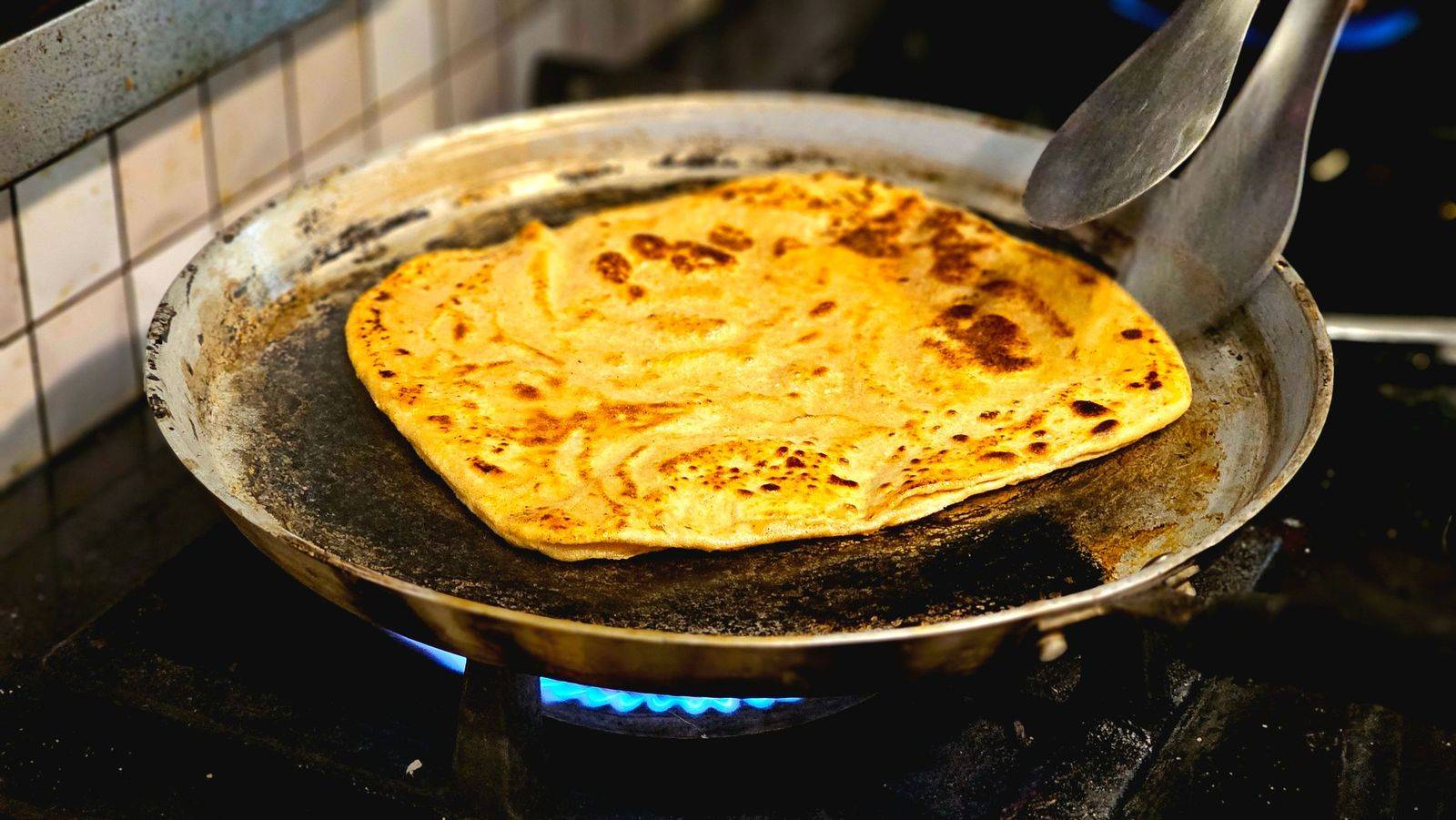
189calories
Protein
5.3 g
Carbs
28.8 g
Fat
7.0 g
Founding 500
Your paratha is not exactly 60 g.
Katori is an iPhone app that counts your actual plate from one photo. Built for Indian food first.
No spam. One email at launch, then only if it matters. Privacy.
First 500 sign-ups get the badge, paid or free. 10% off Pro annual, expires 30 days after launch, replaces the trial.
About paratha
Also called parantha, plain paratha, sada paratha and tawa paratha.
A paratha is a whole wheat flatbread made by folding fat into the dough, rolling it out in layers and cooking it on a tava with more fat. It is a North Indian breakfast staple and the base of every stuffed paratha, from aloo to paneer. Our plain paratha is 40 g of whole wheat flour with 6 g of ghee, cooked to 60 g.
Home vs restaurant
The dough is the same in every row. A restaurant or dhaba puts more ghee on the tava, and the oil row swaps all 6 g of ghee for soybean oil.
| Version | Weight | Calories | Protein | Fat |
|---|---|---|---|---|
| Plain paratha, homeHeadline6 g of ghee, in the layers and on the tava. | 60 g | 189 | 5.3 g | 7.0 g |
| Restaurant or dhaba6 g of ghee on the tava instead of 2. | 64 g | 224 | 5.3 g | 10.9 g |
| Cooked in oil6 g of soybean oil in place of the ghee. | 60 g | 189 | 5.3 g | 7.0 g |
Layers mean fat
A paratha is roti dough folded around fat. Ours takes 40 g of whole wheat flour and 4 g of ghee brushed between the layers before it is rolled out, then 2 g more on the tava. Those 6 g of ghee carry 28 percent of the paratha's 189 calories. Our plain roti, from 30 g of flour and no fat at all, is 102.
A restaurant or dhaba paratha takes more ghee on the tava, 6 g in place of 2, and comes to 224 calories with 10.9 g of fat.
Cooking it in soybean oil changes the kind of fat, not the amount: the oil paratha is 189 calories, and its saturated fat falls from 3.9 g to 1.1 g. For ghee against oil, spoon by spoon, see the ghee page.
From flour to paratha
USDA's survey database weighs a paratha at 70 g and lists 326 calories and 13.2 g of fat per 100 g, against our 314 calories and 11.6 g: close, with a little less fat in ours.[5]
Per 100 g, a plain paratha is 314 calories against 255 for a plain roti: ghee is energy-dense, and the folds hold it. Two plain parathas cost about as much as 3.7 plain rotis.
A frozen shop paratha is heavier: USDA's frozen whole wheat paratha weighs 79 g a piece and comes to 258 calories, with 13.2 g of fat per 100 g.[6]
| One paratha | Grams | Calories |
|---|---|---|
| Flour in the dough (whole wheat flour (atta)) | 40.0 g | 136 |
| Water cooked off | 10.0 g | 0 |
| The finished bread | 60.0 g | 189 |
Log the bread you eat by its own count or weight, not the flour that went into it: water goes into the dough and part of it cooks off, so the two weights never match.
Stuffed parathas
Every stuffed paratha on this site starts from 40 g of whole wheat flour too, with the filling in place of the ghee in the layers. Per piece they all run heavier than our plain paratha at 189; per 100 g the vegetable ones run lighter, 203 for aloo against 314 plain, because the vegetables are mostly water.
Aloo paratha, at 242 calories, has its own page. Gobi, mooli, paneer and mix veg paratha are here, each with its home, restaurant or dhaba and oil versions.
A breakfast of two plain parathas with a 150 g katori of curd is 469 calories and 15.8 g of protein; with a 5 g pat of butter on top, 504.
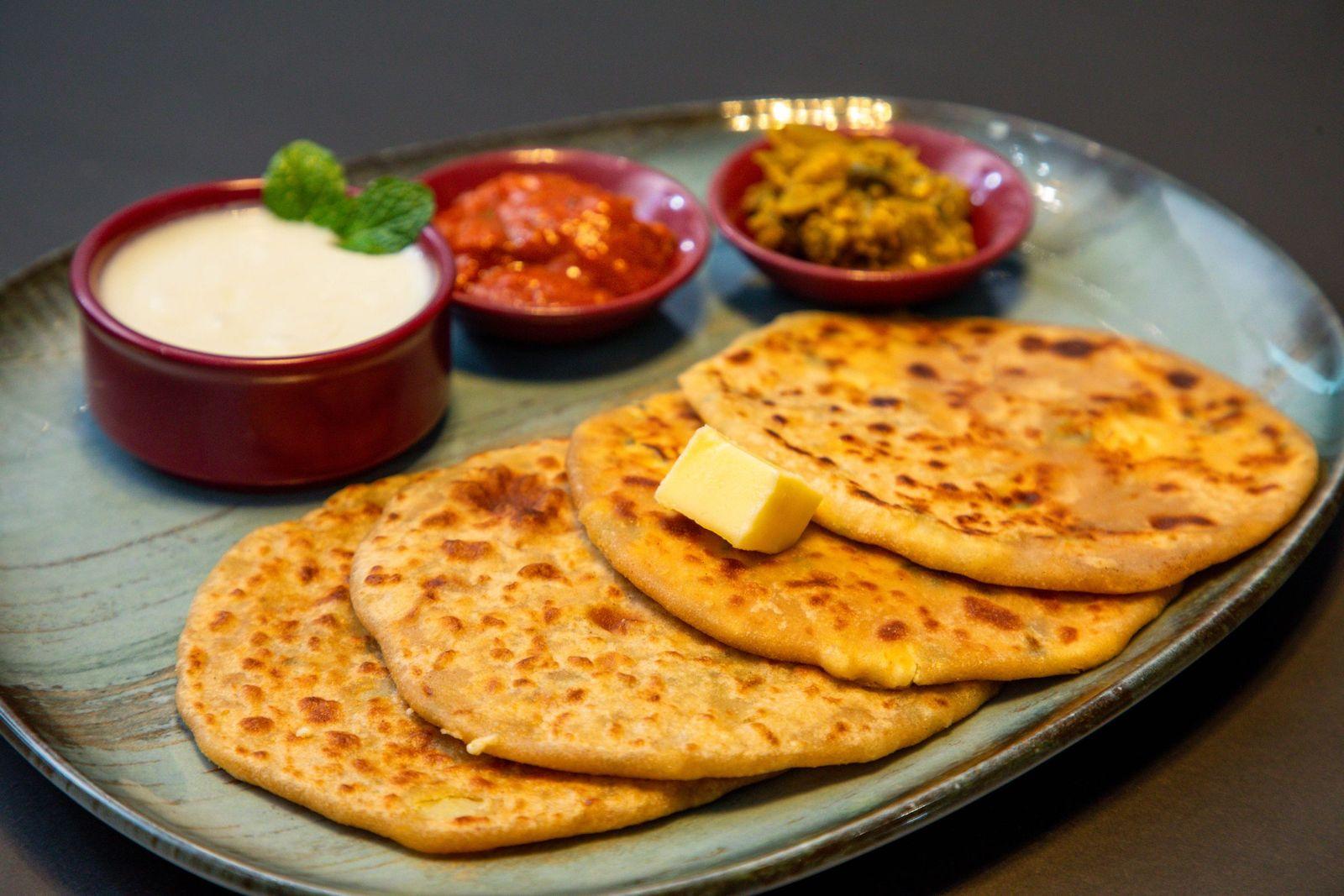
Gobi paratha
50 g of grated cauliflower with 5 g of onion and 1 g of oil: 23 calories, 11 percent of a 109 g paratha of 212 calories.
Cauliflower is 92 percent water, and 15 g of water cooks off on the tava, so a gobi paratha lands 30 calories under an aloo paratha. Some cooks fry the grated cauliflower first so the paratha rolls without tearing; only more oil in the pan would add to the count.
| Version | Weight | Calories | Protein | Fat |
|---|---|---|---|---|
| Home, 6 g ghee on the tavaHeadline | 109 g | 212 | 6.3 g | 8.1 g |
| Restaurant or dhaba, 10 g ghee and 8 g butter | 121 g | 304 | 6.4 g | 18.6 g |
| Cooked in 6 g soybean oil | 109 g | 212 | 6.3 g | 8.1 g |
Correction, October 22, 2026: rebuilt from a stated recipe using USDA FoodData Central values. One gobi paratha was 210 calories; it is now 212.
Mooli paratha
60 g of grated mooli, salted and squeezed of 20 g of water so the dough does not tear, with 1 g of oil: 20 calories, 9 percent of a 96 g paratha of 208 calories.
Squeezing removes water, not calories, and the squeezed water can go back into the dough without changing the count. Outside India mooli is sold as daikon; the USDA record we use is the oriental radish.
| Version | Weight | Calories | Protein | Fat |
|---|---|---|---|---|
| Home, 6 g ghee on the tavaHeadline | 96 g | 208 | 5.7 g | 8.0 g |
| Restaurant or dhaba, 10 g ghee and 8 g butter | 108 g | 301 | 5.7 g | 18.5 g |
| Cooked in 6 g soybean oil | 96 g | 209 | 5.6 g | 8.1 g |
Correction, October 22, 2026: rebuilt from a stated recipe using USDA FoodData Central values. One mooli paratha was 190 calories; it is now 208.
Paneer paratha
40 g of crumbled paneer with 5 g of onion: 130 calories, 41 percent of a 103 g paratha of 319 calories, far more than any vegetable filling, because paneer is fat and protein rather than water.
It is the stuffed paratha with real protein: 14.6 g, against 6.5 g in an aloo paratha, 64 percent of it from the paneer. Our paneer is the median of four US paneer labels, because USDA's survey record keeps the milk sugar that real paneer drains away with the whey.
| Version | Weight | Calories | Protein | Fat |
|---|---|---|---|---|
| Home, 6 g ghee on the tavaHeadline | 103 g | 319 | 14.6 g | 17.0 g |
| Restaurant or dhaba, 10 g ghee and 8 g butter | 115 g | 411 | 14.7 g | 27.4 g |
| Cooked in 6 g soybean oil | 103 g | 319 | 14.6 g | 17.0 g |
Correction, October 22, 2026: rebuilt from a stated recipe using USDA FoodData Central values. One paneer paratha was 270 calories; it is now 319.
Mix veg paratha
20 g of cauliflower, 20 g of carrot, 15 g of potato and 5 g of onion with 1 g of oil: 36 calories, 16 percent of a 115 g paratha of 224 calories.
The potato carries the largest part, so a mix with more potato moves toward aloo paratha's 242; put potato in place of the cauliflower and it rises to 235.
| Version | Weight | Calories | Protein | Fat |
|---|---|---|---|---|
| Home, 6 g ghee on the tavaHeadline | 115 g | 224 | 6.2 g | 8.1 g |
| Restaurant or dhaba, 10 g ghee and 8 g butter | 127 g | 317 | 6.3 g | 18.6 g |
| Cooked in 6 g soybean oil | 115 g | 225 | 6.2 g | 8.1 g |
Correction, October 22, 2026: rebuilt from a stated recipe using USDA FoodData Central values. One mix veg paratha was 215 calories; it is now 224.
Is paratha healthy?
The base is the same whole wheat as a roti, with 4.3 g of fibre in a paratha. The difference is fat: 7.0 g, against 0.8 g in a plain roti, most of it ghee. One paratha is 15 calories less than two plain rotis at 204, which carry 6.4 g of fibre between them. Its 3.9 g of saturated fat comes almost all from the ghee; the flour carries 0.2 g.
What studies of grains and bread found
These findings are about grains and fibre in general, not one bread. One paratha here is 189 calories with 4.3 g of fibre.
- Fibre and whole grains: a series of systematic reviews and meta-analyses found the greatest risk reductions at 25 to 29 g of dietary fibre a day, with similar findings for whole grains, and its authors expect replacing refined grains with whole grains to benefit health.[7]
- Bread or rice with a meal: in a Delhi study of a full dal and vegetable meal, the version with two rotis and the version with rice had almost the same glycemic index, 85.5 and 83.6.[8]
- Whole grain is not the same as low GI: a study of 12 traditional Indian foods found that being made from whole grain does not, on its own, give a food a lower glycemic index.[9]
If you manage your weight or your blood sugar for a medical reason, ask your doctor or a registered dietitian how bread fits your plan.
Every bread, one piece each
| Bread, one piece | Weight | Calories | Protein | Fat | Fibre |
|---|---|---|---|---|---|
| Aloo paratha | 119 g | 242 | 6.5 g | 8.0 g | 5.5 g |
| Roti | 40 g | 102 | 4.0 g | 0.8 g | 3.2 g |
| Naan | 90 g | 258 | 7.0 g | 3.2 g | 1.6 g |
| Paratha | 60 g | 189 | 5.3 g | 7.0 g | 4.3 g |
| Gobi paratha | 109 g | 212 | 6.3 g | 8.1 g | 5.4 g |
| Paneer paratha | 103 g | 319 | 14.6 g | 17.0 g | 4.4 g |
| Mooli paratha | 96 g | 208 | 5.7 g | 8.0 g | 5.2 g |
| Mix veg paratha | 115 g | 224 | 6.2 g | 8.1 g | 5.6 g |
| Butter naan | 96 g | 301 | 7.0 g | 8.1 g | 1.6 g |
| Garlic naan | 100 g | 307 | 7.3 g | 8.1 g | 1.7 g |
| Cheese naan | 120 g | 347 | 13.6 g | 9.9 g | 1.6 g |
| Peshwari naan | 155 g | 528 | 11.7 g | 18.3 g | 5.4 g |
Related guide: Homemade vs Restaurant Indian Food: Calorie Gap
How we calculated this
Every number on this page is for 1 plain paratha (60 g), worked out from the recipe below. A version with its own weight in the table above is worked out at that weight, and the 100 g figures are scaled from the finished paratha.
Correction, October 22, 2026: rebuilt from a stated recipe using USDA FoodData Central values. One paratha was 200 calories; it is now 189.
- Whole wheat flour (atta)40 g
- Ghee in the layers4 g
- Water24 g
- Ghee on the tava2 g
- Water lost on the tava10 g lost
- Salttrace
One plain home paratha: 40 g of whole wheat flour, 4 g of ghee in the layers and 2 g on the tava.
Ingredient values from USDA FoodData Central. Cross-checked per 100 g against USDA's survey paratha and its frozen whole wheat paratha.
Confidence: high
Sources
- USDA FoodData Central 168893: Wheat flour, whole-grain (Includes foods for USDA's Food Distribution Program)
- USDA FoodData Central 173412: Butter oil, anhydrous
- USDA FoodData Central 170923: Spices, cumin seed
- USDA FoodData Central 171411: Oil, soybean, salad or cooking
- USDA FoodData Central 2707715: Bread, paratha
- USDA FoodData Central 174076: Bread, paratha, whole wheat, commercially prepared, frozen
- Reynolds A, Mann J, Cummings J, Winter N, Mete E, Te Morenga L. Carbohydrate quality and human health: a series of systematic reviews and meta-analyses. Lancet, 2019.
- Nayar S, Madhu SV. Glycemic index of wheat and rice are similar when consumed as part of a North Indian mixed meal. Indian J Endocrinol Metab, 2020.
- Shobana S, Geetha G, Bai MR, et al. Carbohydrate profiling and glycaemic indices of selected traditional Indian foods. Indian J Med Res, 2022.
Common questions
Why is paratha so high in calories?
Because of the fat folded into it. Our paratha has 6 g of ghee in the layers and on the tava, 28 percent of its 189 calories. A plain roti has none and is 102.
Is paratha healthier than naan?
By the numbers on this site, a plain paratha is 189 calories with 4.3 g of fibre and 7.0 g of fat, and a plain naan 258 calories with 1.6 g of fibre and 3.2 g of fat. The paratha is whole wheat and lighter per piece; the naan has less fat.
How many calories in 1 paratha?
About 189 for a 60 g plain paratha made at home, or 314 per 100 g. A restaurant paratha with more ghee is 224.
How many calories in 2 parathas?
About 377 for two plain home parathas, and 447 for two restaurant ones.
Is a paratha cooked in oil healthier than one in ghee?
The calories are the same, 189 against 189. The oil paratha carries 1.1 g of saturated fat against 3.9 g.
How much protein is in a paratha?
About 5.3 g in a plain paratha, from the whole wheat flour. A paneer paratha carries 14.6 g.
Is parotta the same as paratha?
No. Parotta is a different bread, and the numbers on this page are for the whole wheat paratha of North India.
Is paratha good for weight loss?
A plain paratha is 189 calories against 102 for a plain roti, and most of the difference is the 6 g of ghee, at about 8.8 calories a gram. Less fat on the tava is the easy change.
These figures are estimates from stated recipes, for general information. They are not medical or dietary advice. If you manage a health condition, check with a registered dietitian or your doctor.
Related dishes
Founding 500
Be one of the original 500.
Permanent badge, plus 10% off your first year of Pro.
Snap one photo and get these numbers for your actual plate, not a generic entry. Built for Indian food first.
No spam. One email at launch, then only if it matters. Privacy.
First 500 sign-ups get the badge, paid or free. 10% off Pro annual, expires 30 days after launch, replaces the trial.