Roti calories: 1 roti, 2 rotis and 100 g
By Shivam Verma Updated 10 sources linked below
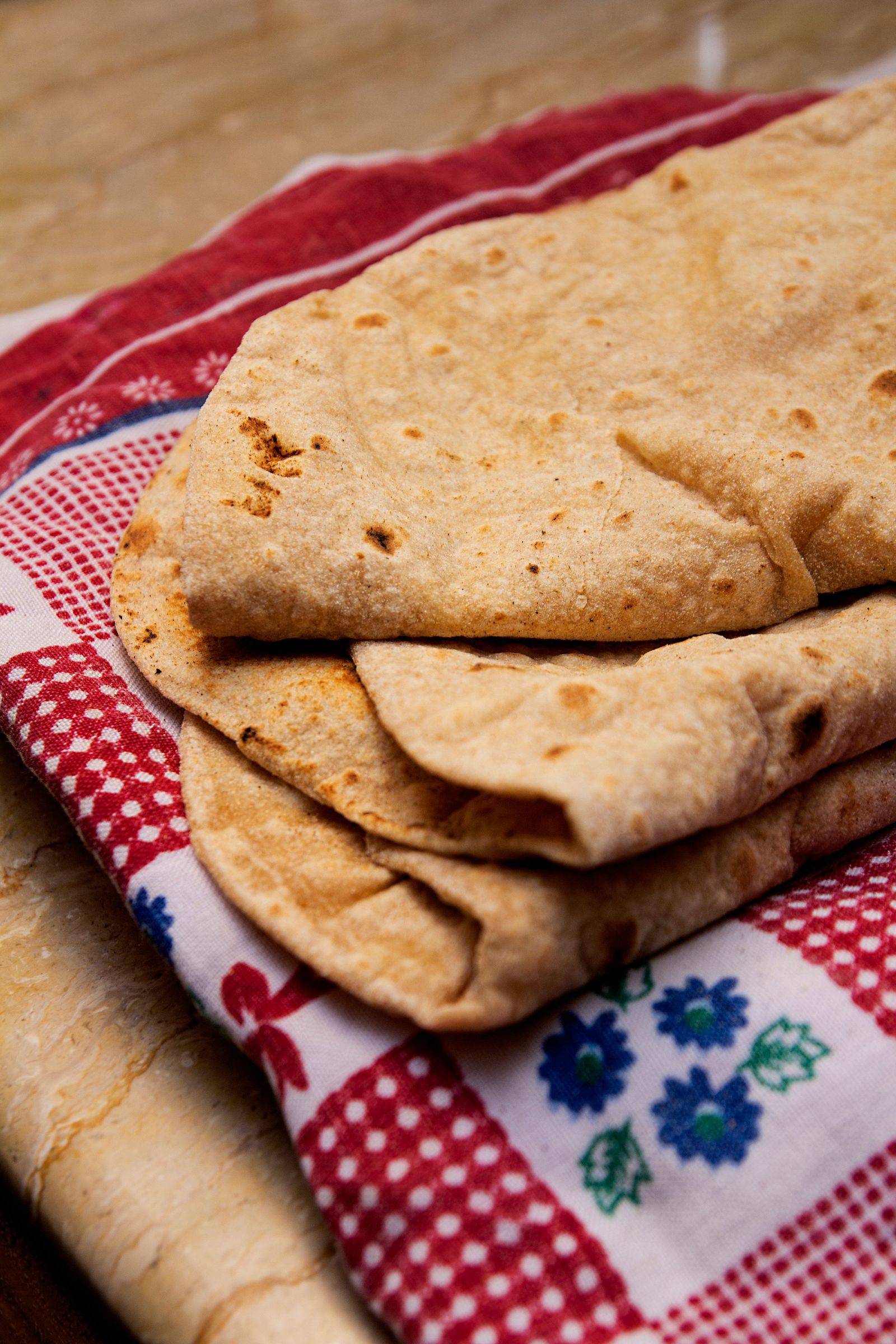
One plain roti (40 g), the phulka made from whole wheat flour and water, has about 102 calories, with 4.0 g protein and 3.2 g fibre: 255 calories per 100 g. A teaspoon of ghee on top takes it to 140. A restaurant tandoori roti, bigger and brushed with butter, is about 189.
102calories
Protein
4.0 g
Carbs
21.6 g
Fat
0.8 g
Founding 500
Your roti is not exactly 40 g.
Katori is an iPhone app that counts your actual plate from one photo. Built for Indian food first.
No spam. One email at launch, then only if it matters. Privacy.
First 500 sign-ups get the badge, paid or free. 10% off Pro annual, expires 30 days after launch, replaces the trial.
About roti
Also called chapati, phulka, rotli and fulka.
Roti is unleavened whole wheat flatbread, rolled thin and cooked on a hot tava, and an everyday bread across North Indian meals. It is the same dough as chapati and phulka, atta and water with no fat in the dough. Our roti is the plain phulka: 30 g of whole wheat flour cooked to a 40 g bread. Ghee on top, a bigger size or a tandoor changes the number, and the table below shows each.
Home vs restaurant
The plain phulka is our headline. The other rows add a teaspoon of ghee, shrink the roti to 20 g of flour, or make the bigger, butter-brushed tandoori roti a restaurant serves.
| Version | Weight | Calories | Protein | Fat |
|---|---|---|---|---|
| Plain phulkaHeadlineWhole wheat flour and water, no fat. | 40 g | 102 | 4.0 g | 0.8 g |
| With 1 tsp ghee4.3 g of ghee spread on top. | 44 g | 140 | 4.0 g | 5.0 g |
| Small phulkaThe same dough from 20 g of flour. | 27 g | 68 | 2.6 g | 0.5 g |
| Tandoori rotiThe restaurant bread: 45 g of flour, baked in a tandoor and brushed with 5 g of butter. | 65 g | 189 | 6.0 g | 5.2 g |
Phulka, chapati and tandoori roti
Phulka and chapati are the same whole wheat dough. A phulka is puffed over an open flame and usually served without fat; a chapati is cooked on the tava and is often spread with ghee. Our plain 40 g phulka is 102 calories, and with a teaspoon of ghee, 4.3 g, it is 140: the ghee adds 38, more than a third of the plain roti.
Size moves it as much as fat does. A small phulka from 20 g of flour is 68 calories. A tandoori roti, baked against the wall of a tandoor from 45 g of flour and brushed with 5 g of butter, is 189.
Tandoori roti is the restaurant's everyday bread, slapped onto the tandoor wall like naan but made from whole wheat dough with no curd or milk. Most of its extra over our phulka is size, 45 g of flour against 30 g, plus the butter.
Against naan the gap is wide. A plain naan is 258 calories, so one naan costs about the same as 2.5 plain phulkas, and even the restaurant tandoori roti comes in 69 calories under it.
Flour, water and the tava
A roti is mostly flour and water. Ours starts from 30 g of whole wheat flour and 18 g of water; about 8 g of the water leaves on the tava and over the flame, so the finished roti weighs 40 g and is about 33 percent water, close to USDA's commercial chapati at 33 percent.[5]
The 30 g of flour is our recipe. The 40 g roti it makes is the weight USDA's survey record for chapati or roti gives a medium seven-inch one, 40 g.[7]
USDA's commercial chapati records carry more fat than a home phulka, 7.45 and 9.2 g per 100 g against our 1.9 g, which is most of why they read 297 and 299 calories per 100 g against our 255.[5][6]
| One roti | Grams | Calories |
|---|---|---|
| Flour in the dough (whole wheat flour (atta)) | 30.0 g | 102 |
| Water cooked off | 8.0 g | 0 |
| The finished bread | 40.0 g | 102 |
Log the bread you eat by its own count or weight, not the flour that went into it: water goes into the dough and part of it cooks off, so the two weights never match.
Small, medium and large rotis
USDA's survey database sizes chapatis by width: a small six-inch one at 27 g, a medium seven-inch one at 40 g and a large eight-inch one at 52 g.[7]
Made from our dough, those three come to 69, 102 and 133 calories. A roti that fills the tava is closer to the large one, and a thin, palm-sized phulka to the small. Our small phulka, from 20 g of flour, weighs 26.7 g, almost exactly USDA's small chapati.
Ghee, butter or oil on a roti
A teaspoon of fat adds about the same calories whichever fat it is: 4.3 g of ghee is 38, a teaspoon of butter, 4.7 g, is 34, and a teaspoon of oil, 4.5 g, is 40. Butter is the lightest of the three because part of it is water.
The saturated fat is what differs: 2.7 g in the teaspoon of ghee, 2.4 g in the butter and 0.7 g in the soybean oil.
What atta brings
Atta is whole wheat flour, ground with its bran and germ. Per 100 g, USDA lists 340 calories, 13.2 g of protein and 10.7 g of fibre, against 364 calories, 10.3 g and 2.7 g for white flour. In a roti that becomes 3.2 g of fibre; a piece of our naan of the same 40 g weight carries 0.7 g.
Shop-bought roti
A packet roti is not a home phulka, so if that is the roti on your plate, read the packet's per piece figure rather than ours. USDA's frozen whole wheat roti weighs 43 g a piece and comes to 129 calories, and its commercial chapati weighs 68 g and comes to 202, both with fat in the dough.[6][5]
Roti, protein and ghee
A plain roti carries 4.0 g of protein, 15 percent of its calories. Two rotis with a 150 g katori of curd, at 92 calories, bring 13.1 g together.
A roti with a teaspoon of ghee, at 140 calories, is still lighter than a plain paratha at 189, which folds 6 g of ghee into 40 g of flour. Rolling the same 30 g of flour thinner makes a wider roti, not a heavier one: the calories follow the flour, not the diameter.
Is roti healthy?
A plain roti is whole wheat and water, so its 3.2 g of fibre comes with only 0.8 g of fat: 79 percent of its calories are carbohydrate and 15 percent protein. The fat you add decides the rest. A teaspoon of ghee makes it 140 calories and takes the fat to 5.0 g.
What studies of grains and bread found
These findings are about grains and fibre in general, not one bread. One roti here is 102 calories with 3.2 g of fibre.
- Fibre and whole grains: a series of systematic reviews and meta-analyses found the greatest risk reductions at 25 to 29 g of dietary fibre a day, with similar findings for whole grains, and its authors expect replacing refined grains with whole grains to benefit health.[8]
- Bread or rice with a meal: in a Delhi study of a full dal and vegetable meal, the version with two rotis and the version with rice had almost the same glycemic index, 85.5 and 83.6.[9]
- Whole grain is not the same as low GI: a study of 12 traditional Indian foods found that being made from whole grain does not, on its own, give a food a lower glycemic index.[10]
If you manage your weight or your blood sugar for a medical reason, ask your doctor or a registered dietitian how bread fits your plan.
Every bread, one piece each
| Bread, one piece | Weight | Calories | Protein | Fat | Fibre |
|---|---|---|---|---|---|
| Aloo paratha | 119 g | 242 | 6.5 g | 8.0 g | 5.5 g |
| Roti | 40 g | 102 | 4.0 g | 0.8 g | 3.2 g |
| Naan | 90 g | 258 | 7.0 g | 3.2 g | 1.6 g |
| Paratha | 60 g | 189 | 5.3 g | 7.0 g | 4.3 g |
| Gobi paratha | 109 g | 212 | 6.3 g | 8.1 g | 5.4 g |
| Paneer paratha | 103 g | 319 | 14.6 g | 17.0 g | 4.4 g |
| Mooli paratha | 96 g | 208 | 5.7 g | 8.0 g | 5.2 g |
| Mix veg paratha | 115 g | 224 | 6.2 g | 8.1 g | 5.6 g |
| Butter naan | 96 g | 301 | 7.0 g | 8.1 g | 1.6 g |
| Garlic naan | 100 g | 307 | 7.3 g | 8.1 g | 1.7 g |
| Cheese naan | 120 g | 347 | 13.6 g | 9.9 g | 1.6 g |
| Peshwari naan | 155 g | 528 | 11.7 g | 18.3 g | 5.4 g |
Related guide: Roti vs Rice: Which Is Better for Weight Loss?
How we calculated this
Every number on this page is for 1 medium roti (40 g), worked out from the recipe below. A version with its own weight in the table above is worked out at that weight, and the 100 g figures are scaled from the finished roti.
Correction, October 22, 2026: rebuilt from a stated recipe using USDA FoodData Central values. One roti was 110 calories; it is now 102.
- Whole wheat flour (atta)30 g
- Water18 g
- Water lost on the tava8 g lost
- Salt, optionaltrace
One plain phulka from 30 g of whole wheat flour, our recipe; about 8 g of water leaves on the tava, for the 40 g a medium roti weighs in USDA's survey record.
Ingredient values from USDA FoodData Central. Cross-checked per 100 g against USDA's commercial chapati, its frozen whole wheat roti and its survey chapati.
Confidence: high
Sources
- USDA FoodData Central 168893: Wheat flour, whole-grain (Includes foods for USDA's Food Distribution Program)
- USDA FoodData Central 170923: Spices, cumin seed
- USDA FoodData Central 173412: Butter oil, anhydrous
- USDA FoodData Central 173410: Butter, salted
- USDA FoodData Central 171844: Bread, chapati or roti, plain, commercially prepared
- USDA FoodData Central 174075: Bread, chapati or roti, whole wheat, commercially prepared, frozen
- USDA FoodData Central 2707713: Bread, chappatti or roti
- Reynolds A, Mann J, Cummings J, Winter N, Mete E, Te Morenga L. Carbohydrate quality and human health: a series of systematic reviews and meta-analyses. Lancet, 2019.
- Nayar S, Madhu SV. Glycemic index of wheat and rice are similar when consumed as part of a North Indian mixed meal. Indian J Endocrinol Metab, 2020.
- Shobana S, Geetha G, Bai MR, et al. Carbohydrate profiling and glycaemic indices of selected traditional Indian foods. Indian J Med Res, 2022.
Common questions
How many calories does 1 roti have?
About 102 for a 40 g plain phulka, or 255 per 100 g. With a teaspoon of ghee it is 140, and a restaurant tandoori roti with butter is 189.
Is roti ok for weight loss?
A plain roti is 102 calories with 3.2 g of fibre, lighter per piece than a plain naan at 258 or a plain paratha at 189. How many you eat, and the ghee on top, matter more than the roti itself.
Is 2 roti too much?
Two plain rotis are 204 calories and 7.9 g of protein; with a teaspoon of ghee on each, 279. Whether that is too much depends on the rest of the plate, not the rotis alone.
Is roti good or bad carbs?
Roti's carbohydrate comes from whole wheat flour: 21.6 g in a 40 g roti, with 3.2 g of fibre. Being whole grain does not on its own make a food low glycemic index, as the research summary on this page notes, but it does keep the bran and its fibre.
How many chapatis are 500 calories?
About 5 plain rotis of 40 g each, at 102 calories a roti, or 4 with a teaspoon of ghee on each.
Which is better, rice or chapati?
A katori of rice is 156 calories and two plain rotis 204, with 6.4 g of fibre against 0.5 g. A Delhi study found a dal meal with two rotis and the same meal with rice had almost the same glycemic index. The roti vs rice guide has the full comparison.[9]
How many calories in roti with ghee?
About 140 for a plain roti with a teaspoon of ghee, 4.3 g. The ghee alone adds 38.
Is chapati the same as roti?
Yes. Roti, chapati, phulka, rotli and fulka are names for the same whole wheat flatbread; a phulka is the one puffed over a flame. The numbers on this page apply to all of them.
These figures are estimates from stated recipes, for general information. They are not medical or dietary advice. If you manage a health condition, check with a registered dietitian or your doctor.
Related dishes
Founding 500
Be one of the original 500.
Permanent badge, plus 10% off your first year of Pro.
Snap one photo and get these numbers for your actual plate, not a generic entry. Built for Indian food first.
No spam. One email at launch, then only if it matters. Privacy.
First 500 sign-ups get the badge, paid or free. 10% off Pro annual, expires 30 days after launch, replaces the trial.