Paneer calories and protein: 100 g, 1 oz and 200 g
By Shivam Verma Updated 9 sources linked below
100 g of paneer has about 321 calories, 23.2 g of protein, 25.0 g of fat and 3.6 g of carbohydrate. A 1 oz piece (28 g) is about 90 calories with 6.5 g of protein, and 200 g is 642. These are the median of four US paneer labels in USDA's database; USDA's own survey record lists 22.5 g of carbs.
321calories
Protein
23.2 g
Carbs
3.6 g
Fat
25.0 g
Founding 500
Your piece of paneer is not exactly 100 g.
Katori is an iPhone app that counts your actual plate from one photo. Built for Indian food first.
No spam. One email at launch, then only if it matters. Privacy.
First 500 sign-ups get the badge, paid or free. 10% off Pro annual, expires 30 days after launch, replaces the trial.
About paneer
Also called cottage cheese (in India) and Indian cottage cheese.
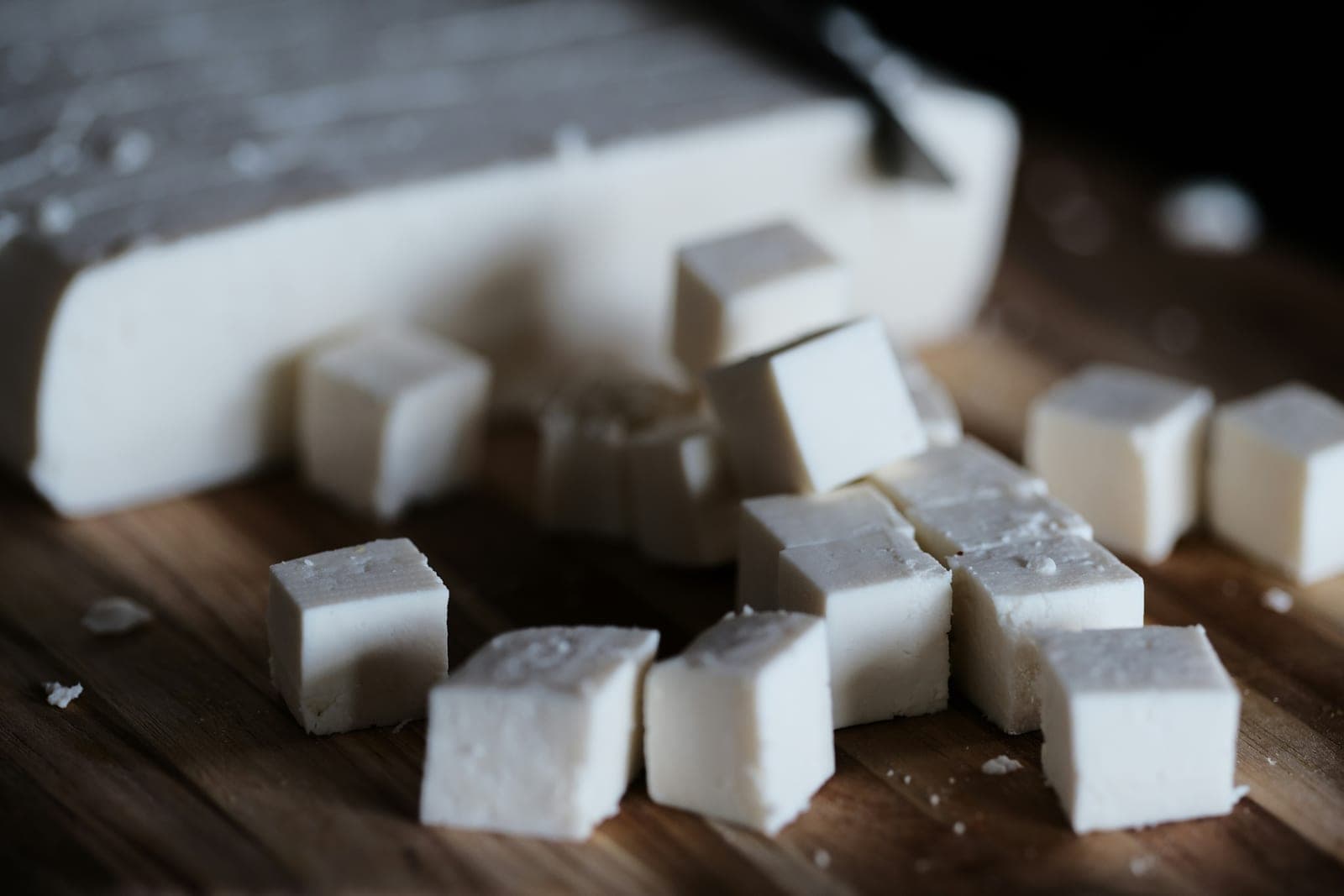
Paneer is fresh Indian cheese: hot milk split with an acid such as lemon juice or vinegar, the curds strained from the whey and pressed into a block. It is not aged and does not melt, so it holds its shape in a curry or on a skewer. In India it is often called cottage cheese. US cottage cheese is a different product, loose wet curds often mixed with cream, so it is not an alias here and its numbers are not paneer's. Every headline number on this page is the median of the four paneer labels sold in the US that USDA lists in its Branded Foods database: per 100 g, 321 calories, 23.2 g of protein, 25.0 g of fat, 17.0 g of it saturated, and 3.6 g of carbohydrate. All four labels state a serving of 28 g, one ounce, which is where the 1 oz figure comes from.
The labels against USDA's survey record
USDA has two kinds of record for paneer, and they disagree on carbohydrate. The four US labels in its Branded database list 0 to 3.6 g of carbohydrate per 100 g. Its survey record, FNDDS "Cheese, paneer", lists 22.5 g, with 23.3 g of sugars.[5]
The gap comes from how each is built. The survey record is a recipe, not a lab sample: 97 g of whole milk and 3 g of vinegar, with 80 percent of the weight cooked off as water, so 100 g of ingredients becomes 20 g of paneer holding 41.5 g of water per 100 g. Every gram of the milk's sugar stays in.[5]
In a kitchen, paneer is made by draining away the whey, and most of the milk sugar leaves with it. That is why the labels, which describe the paneer itself, carry so little. So these are two models of the same food rather than a right number and a wrong one: the survey record models milk boiled down with all its solids, and the labels describe paneer as it is sold, after the whey is gone. Calories land much closer: 299 per 100 g in the survey record, inside the labels' range of 286 to 321, because the survey paneer's lower fat, 15.5 g, is partly offset by its sugar.
For paneer from a shop, use the label on your pack, or the label median on this page if the pack has none. If a food diary shows paneer at about 299 calories and 22.5 g of carbs per 100 g, it is reading the survey record.
The labels have their own rounding. Each states its nutrients for a 28 g serving in whole grams, and USDA scales that serving up to 100 g, so 1 g of carbohydrate on a label becomes 3.6 g per 100 g: the 3.6 g figure is a label that said 1 g. Calories carry the same effect. The labels' median protein, carbohydrate and fat come to 332 calories at 4, 4 and 9 calories a gram, against the 321 the labels state. This page uses the stated 321, the figure printed on the pack.[1][2][3][4]
| Record | Calories | Protein | Carbs | Sugars | Fat |
|---|---|---|---|---|---|
| FDC 2429587, US label | 321 | 25.0 g | 3.6 g | 3.6 g | 25.0 g |
| FDC 2597884, US label | 321 | 25.0 g | 0.0 g | 0.0 g | 25.0 g |
| FDC 2053888, US label | 286 | 21.4 g | 3.6 g | 3.6 g | 17.9 g |
| FDC 1958246, US label | 321 | 21.4 g | 3.6 g | 0.0 g | 28.6 g |
| Median of the four labels (this page) | 321 | 23.2 g | 3.6 g | 1.8 g | 25.0 g |
| FDC 2705740, USDA survey record | 299 | 15.9 g | 22.5 g | 23.3 g | 15.5 g |
Per 100 g. The labels state a 28 g serving, which USDA scales to 100 g.
Paneer, tofu and chicken
Paneer has the most calories of the three, because 25 percent of its weight is fat. Per 100 g, paneer has 321 calories and 23.2 g of protein, firm tofu 144 calories and 17.3 g, and roasted chicken breast 165 calories and 31.0 g.[6][7]
Protein per 100 calories sets them side by side: 7.2 g for paneer, 12.0 g for tofu and 18.8 g for chicken breast. To eat 25 g of protein you would eat about 108 g of paneer at 346 calories, 145 g of tofu at 208, or 81 g of chicken breast at 133.
Saturated fat separates them most: 17.0 g per 100 g in paneer, 1.3 g in tofu and 1.0 g in chicken breast. Tofu is the only one of the three with fibre, 2.3 g.
| Per 100 g | Calories | Protein | Fat | Saturated fat | Protein per 100 calories |
|---|---|---|---|---|---|
| Paneer (label median) | 321 | 23.2 g | 25.0 g | 17.0 g | 7.2 g |
| Tofu, firm, raw | 144 | 17.3 g | 8.7 g | 1.3 g | 12.0 g |
| Chicken breast, roasted | 165 | 31.0 g | 3.6 g | 1.0 g | 18.8 g |
Tofu is FDC 172475, prepared with calcium sulfate; chicken is FDC 171477, breast meat only, roasted.
Homemade paneer
Homemade paneer is made the same way, and how long it is pressed decides most of its numbers. Pressed under a weight until firm, it sits close to the labels. Left soft, it keeps more whey water, and the same calories spread over more grams.
Soft, unpressed curd is called chhena. On our rasmalai page, where chhena is the base of each disc, we model it as 76 g of paneer plus 24 g of water per 100 g, a stated assumption rather than a measurement. By that model 100 g of soft homemade paneer is about 244 calories with 17.6 g of protein, against 321 and 23.2 g for pressed paneer from a shop.
The milk moves it too. Paneer from toned or skimmed milk has less fat than paneer from whole milk. One of the four labels lists skim milk next to whole milk in its ingredients, and it is the label with the least fat, 17.9 g per 100 g against the median 25.0 g.
Is paneer healthy?
Paneer is a dense source of both protein and fat. Per 100 g the labels' median is 23.2 g of protein and 25.0 g of fat, 17.0 g of it saturated; all four labels list saturated fat, from 12.5 to 17.9 g.[1][2][3][4]
Portions decide what that means. A 1 oz piece of 28 g has 4.8 g of saturated fat. 200 g of paneer has 642 calories, 46.4 g of protein and 33.9 g of saturated fat.
The NHS says men should not eat more than 30 g of saturated fat a day and women no more than 20 g. 100 g of paneer is 57 percent of the men's figure and 85 percent of the women's, and 200 g is 113 and 170 percent.[8]
The American Heart Association recommends a dietary pattern with 5 to 6 percent of calories from saturated fat, about 11.1 to 13.3 g on a 2,000 calorie day.[9]
The guideline table on the ghee page sets both bodies' advice side by side. Those are descriptions, not a verdict: a few cubes in a palak paneer and a plate of paneer tikka are very different amounts. If you manage your cholesterol or your heart health, ask your doctor or a registered dietitian how much paneer suits you.
Common questions
How many calories are in 100 g of paneer?
About 321 calories, the median of four US paneer labels, with 23.2 g of protein and 25.0 g of fat. USDA's survey record puts it at 299, because it models paneer as milk boiled down with all its sugar kept in.
How much protein is in 100 g of paneer?
23.2 g, the median of the four labels, which range from 21.4 to 25.0 g. That is 7.2 g of protein for every 100 calories. USDA's survey record lists 15.9 g.
How many carbs are in paneer?
Very few on the labels: 0 to 3.6 g per 100 g, with a median of 3.6 g. USDA's survey record lists 22.5 g, because it keeps the milk sugar that paneer loses with the whey. For a pack from a shop, read its label.
Is paneer good for weight loss?
Here are the numbers. 100 g of paneer is 321 calories with 23.2 g of protein, which is 7.2 g of protein per 100 calories, against 12.0 g for firm tofu and 18.8 g for roasted chicken breast. A 50 g portion is 161 calories with 11.6 g of protein.
Paneer or tofu: which has more protein?
Paneer, per 100 g: 23.2 g against 17.3 g in firm tofu. Per calorie it is the other way round. Tofu has 12.0 g of protein per 100 calories and paneer 7.2 g, because paneer carries 25.0 g of fat per 100 g and tofu 8.7 g.
Paneer or chicken: which has more protein?
Chicken breast, at 31.0 g per 100 g roasted against 23.2 g in paneer, with 165 calories against 321. For 25 g of protein that is about 81 g of chicken breast at 133 calories, or 108 g of paneer at 346.
How many calories are in 200 g of paneer?
About 642 calories, with 46.4 g of protein, 50.0 g of fat and 33.9 g of saturated fat, from the four labels' median.
Is homemade paneer different from store-bought?
Pressed firm, homemade paneer from whole milk is close to the labels. Pressed less, it holds more water: modelled as soft chhena, it comes to about 244 calories and 17.6 g of protein per 100 g. Paneer from lower fat milk has less fat, as the one label that lists skim milk shows, 17.9 g against the median 25.0 g.
How we calculated this
The headline numbers on this page are for 100 g, each the median of the four US paneer labels in the Sources below.
- Paneer (median of four US labels)100 g
100 g of paneer. Each nutrient is the median of the four US paneer labels in USDA's Branded Foods database, each label scaled by USDA from its 28 g serving.
Values from USDA FoodData Central (Branded labels), with USDA's survey record and SR Legacy records for comparison.
Confidence: high
Sources
- USDA FoodData Central 2429587 (Branded label): PANEER
- USDA FoodData Central 2597884 (Branded label): PANEER CHEESE
- USDA FoodData Central 2053888 (Branded label): DEEP, INDIAN GOURMET PANEER
- USDA FoodData Central 1958246 (Branded label): HOME-STYLE CHEESE PANEER
- USDA FoodData Central 2705740: Cheese, paneer
- USDA FoodData Central 172475: Tofu, raw, firm, prepared with calcium sulfate
- USDA FoodData Central 171477: Chicken, broilers or fryers, breast, meat only, cooked, roasted
- NHS. Fat: the facts.
- American Heart Association. Saturated fat.
These figures are estimates from stated recipes, for general information. They are not medical or dietary advice. If you manage a health condition, check with a registered dietitian or your doctor.
Related dishes
Founding 500
Be one of the original 500.
Permanent badge, plus 10% off your first year of Pro.
Snap one photo and get these numbers for your actual plate, not a generic entry. Built for Indian food first.
No spam. One email at launch, then only if it matters. Privacy.
First 500 sign-ups get the badge, paid or free. 10% off Pro annual, expires 30 days after launch, replaces the trial.