Dosa calories: 1 dosa, 2 dosas and 100 g
Also called plain dosa, sada dosa and dosai.
By Shivam Verma Updated 11 sources linked below
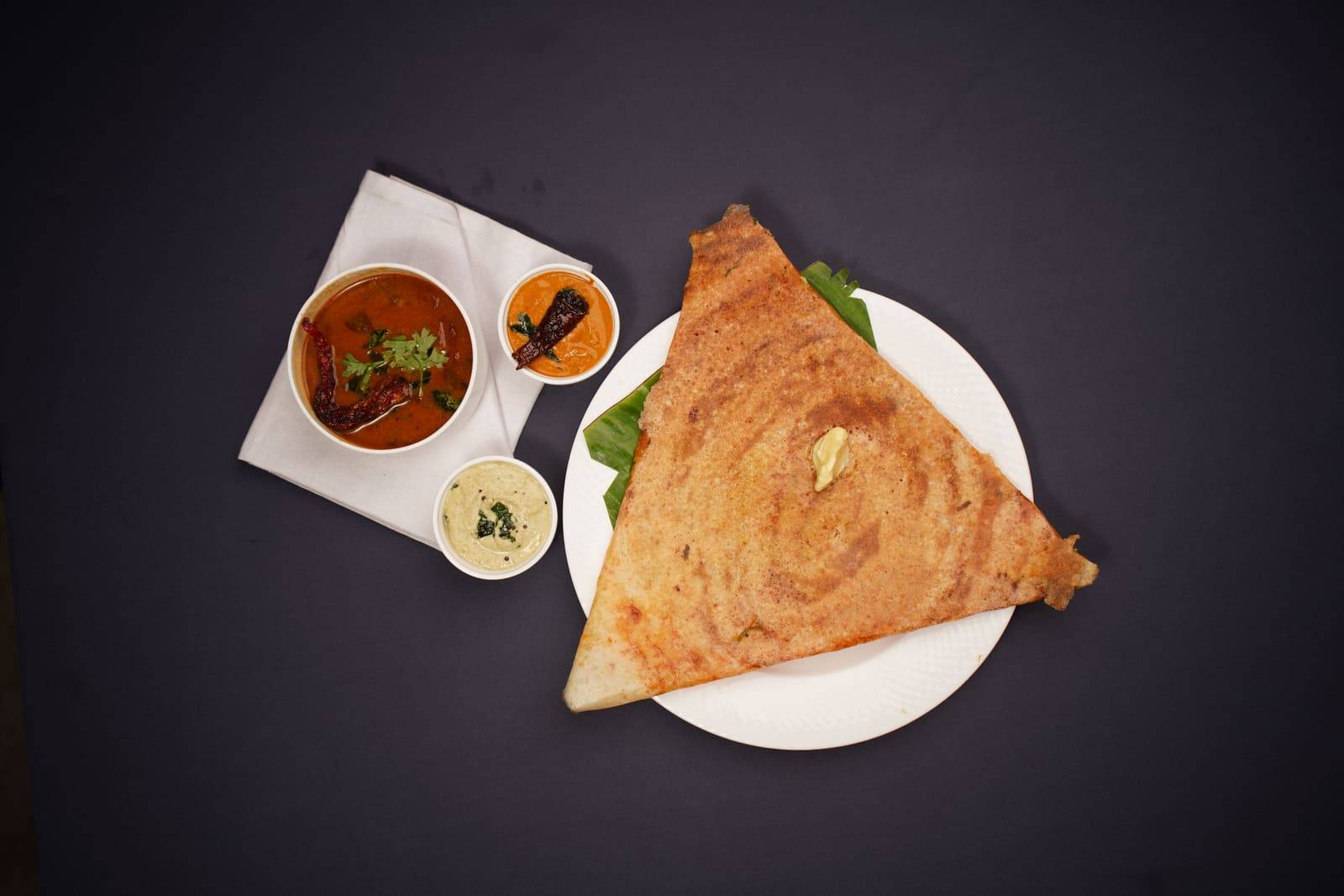
One plain medium dosa, 54 g, has about 136 calories, 3.3 g of protein and 4.3 g of fat, or 252 per 100 g. Two dosas are 272. Cooked on a nonstick pan with almost no oil, one is 109; a restaurant dosa crisped in ghee is 171.
136calories
Protein
3.3 g
Carbs
20.9 g
Fat
4.3 g
Founding 500
Your dosa is not exactly 54 g.
Katori is an iPhone app that counts your actual plate from one photo. Built for Indian food first.
No spam. One email at launch, then only if it matters. Privacy.
First 500 sign-ups get the badge, paid or free. 10% off Pro annual, expires 30 days after launch, replaces the trial.
About dosa
A plain dosa is the same fermented rice and urad batter as idli, spread thin on a hot tava instead of steamed. The thin layer gives up water as it crisps, and the cook adds fat to the pan, so a dosa ends up denser in calories than an idli made from the same batter. Our medium dosa starts from 28 g of dry rice and urad with 35 g of water, loses 13 g on the tava and takes 4 g of oil. That oil is 35 of its calories, and it is the part that changes from kitchen to kitchen.
Home vs takeout
The batter is the same in all three; the fat is not. Home uses 4 g of oil, a nonstick pan 1 g, and a restaurant dosa 8 g of ghee, brushed on so it crisps and browns.
| Version | 1 plain dosa | Protein, 1 plain dosa |
|---|---|---|
| Home, a little oilHeadlineA little oil on the tava. | 136 | 3.3 g |
| Nonstick, almost no oilOne gram of oil. | 109 | 3.3 g |
| Restaurant, gheeGhee brushed on in place of the oil. | 171 | 3.3 g |
The oil on the tava
Every gram of fat on the tava is about nine calories, and our recipes count all of it as eaten. With 1 g on a nonstick pan the dosa is 109 calories and 1.3 g of fat. Our home dosa with 4 g is 136. The restaurant habit of brushing on 8 g of ghee, 70 calories of it, takes one dosa to 171 with 8.2 g of fat, 5.0 g of it saturated against 0.7 g at home.
Per 100 g that is 214, 252 and 294. The batter barely moves between them; the pan does.
Idli and dosa batter is rice and urad dal soaked, ground and left to ferment overnight. We count it as three parts raw rice to one part urad by dry weight; that ratio is our assumption, because home ratios range widely. Fermentation makes the batter rise and sour, and we assume it changes no calories. One plain dosa of dosa here holds 21.0 g of raw rice and 7.0 g of urad dal, 101 of its 136 calories; the rest is water and whatever fat the pan or the filling adds.
Dosa against idli
Two idli use 34 g of dry rice and urad and come to 122 calories; one dosa uses 28 g and comes to 136. Idli keeps its water and takes no fat, so it is 122 calories per 100 g, against 252 for the dosa. Weight for weight the dosa is the richer one, and the difference is the oil and the water the tava drives off: 21 percent of the batter's weight leaves as steam.
Two dosas or one masala dosa
Two plain dosas weigh 108 g and come to 272 calories with 6.5 g of protein. One masala dosa in our recipe is heavier, 137 g, yet comes to 257: its potato filling adds weight for fewer calories than a second dosa's batter and oil would. Ordering the masala dosa instead of a second plain one gives the bigger plate for slightly fewer calories. Two plain dosas with a katori of sambar make a full breakfast of 381.
With sambar and chutney
One dosa with a katori of sambar is 245 calories. Coconut chutney is the richer side: 30 g of it is 77 calories with 6.3 g of fat, more fat than the 4 g of oil on the tava. Stuff the dosa with spiced potato and it becomes a masala dosa, 257 calories for ours.
It usually arrives with sambar and coconut chutney. A katori of sambar here is 150 g from its own recipe, and a serving of coconut chutney 30 g of fresh coconut, roasted chana, a little oil and water.
| Plate | Calories | Protein | Fat |
|---|---|---|---|
| 1 plain dosa of dosa on its own | 136 | 3.3 g | 4.3 g |
| With 1 katori of sambar | 245 | 7.8 g | 8.3 g |
| With 30 g of coconut chutney | 213 | 4.6 g | 10.5 g |
| With both | 322 | 9.1 g | 14.6 g |
The coconut chutney carries most of the side's fat: fresh coconut is about a third fat by weight.
Against USDA's survey record
USDA's survey record for plain dosa is 210 calories per 100 g, and ours is 20 percent above it. It weighs a medium dosa at 80 g, about 168 calories, larger than ours. The record is built differently: lentils in place of urad dal, and a wetter batter, about 47 g of water in every 100 g of its recipe, which is why its dosa is lighter per gram.[11]
Is dosa healthy?
A plain dosa is a modest serving of starch, 20.9 g of carbohydrate with 1.6 g of fibre, and a little protein, 2.4 g for every 100 calories; its fat is whatever the pan adds. Made at home with a light hand it is a reasonable breakfast; the ghee version and the potato filling are where it grows.
One plain of dosa carries 3.3 g of protein and 4.3 g of fat, 0.7 g of it saturated: 2.4 g of protein for every 100 calories. The ghee page sets the NHS and American Heart Association limits for saturated fat side by side.
How we calculated this
Every number on this page is for 1 plain dosa (54 g), worked out from the recipe below. Piece and 100 g figures are scaled from it.
Correction, November 6, 2026: rebuilt from a stated recipe using USDA FoodData Central values, with the batter, the dough and the frying oil each stated in grams. This page listed dosa at 135 calories for 1 plain dosa (medium). It now counts 1 plain dosa (54 g) at 136 calories.
- Rice, raw (in the batter)21 g
- Urad dal, dry (in the batter)7 g
- Water, in the batter35 g
- Oil on the tava4 g
- Water lost on the tava13 g lost
One plain medium dosa of 54 g. The batter is raw rice and urad dal, three to one by dry weight, our assumption; the water lost is what leaves on the tava.
USDA FoodData Central SR Legacy for every ingredient, with USDA's survey record for plain dosa as a cross-check.
Confidence: high
Sources
- USDA FoodData Central 168877: Rice, white, long-grain, regular, raw, enriched
- USDA FoodData Central 174259: Mungo beans, mature seeds, raw
- USDA FoodData Central 171411: Oil, soybean, salad or cooking
- USDA FoodData Central 173412: Butter oil, anhydrous
- USDA FoodData Central 172436: Pigeon peas (red gram), mature seeds, raw
- USDA FoodData Central 169228: Eggplant, raw
- USDA FoodData Central 167763: Tamarinds, raw
- USDA FoodData Central 170923: Spices, cumin seed
- USDA FoodData Central 170169: Nuts, coconut meat, raw
- USDA FoodData Central 173756: Chickpeas (garbanzo beans, bengal gram), mature seeds, raw
- USDA FoodData Central 2708347: Dosa, plain
Common questions
How many calories in 1 dosa?
About 136 for a plain medium dosa of 54 g made at home, with 3.3 g of protein.
Can I eat two dosas during weight loss?
Two home dosas are 272 calories with 6.5 g of protein. Cooked in ghee they are much more, so ask how the dosa is cooked.
Is dosa healthier than rice?
One home dosa is 136 calories; a katori of plain rice is 156. The dosa adds a little urad protein and the tava's fat.
Is dosa healthy or junk?
Neither label fits. The batter is plain rice and urad; the fat on the pan decides the rest, from 109 calories on a nonstick pan to 171 with ghee.
How many calories in a ghee dosa?
About 171 for a medium dosa with 8 g of ghee, against 136 with 4 g of oil.
How many calories in dosa with sambar?
One dosa with a katori of sambar is about 245 calories.
How many calories in 100 g of dosa?
252 for our home dosa, 214 with almost no oil and 294 with ghee.
How much protein is in a dosa?
About 3.3 g in one plain dosa and 6.5 g in two. A katori of sambar beside them is the simplest way to add more.
These figures are estimates from stated recipes, for general information. They are not medical or dietary advice. If you manage a health condition, check with a registered dietitian or your doctor.
Related dishes
Founding 500
Be one of the original 500.
Permanent badge, plus 10% off your first year of Pro.
Snap one photo and get these numbers for your actual plate, not a generic entry. Built for Indian food first.
No spam. One email at launch, then only if it matters. Privacy.
First 500 sign-ups get the badge, paid or free. 10% off Pro annual, expires 30 days after launch, replaces the trial.