Rasmalai calories: 1 piece and 100 g
By Shivam Verma Updated 14 sources linked below
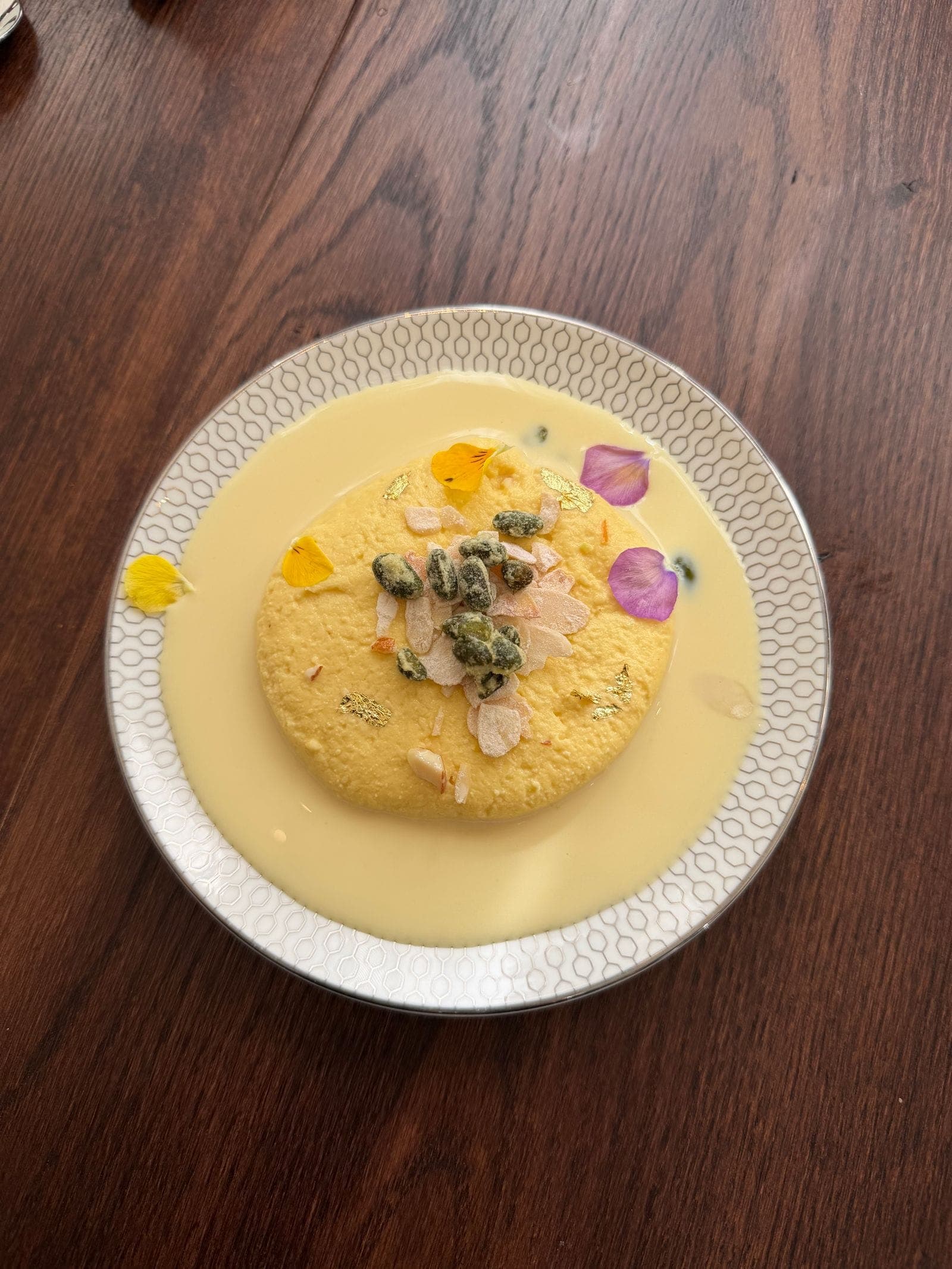
One rasmalai piece, a chhena disc served with its sweetened milk, weighs about 80 g and has 146 calories, or 182 per 100 g. It holds 11 g of added sugar, about 2.6 teaspoons, and 6 g of protein, more than a gulab jamun, kaju katli or jalebi.
146calories
Protein
6.0 g
Carbs
16.5 g
Fat
6.6 g
Founding 500
Your rasmalai is not exactly 80 g.
Katori is an iPhone app that counts your actual plate from one photo. Built for Indian food first.
No spam. One email at launch, then only if it matters. Privacy.
First 500 sign-ups get the badge, paid or free. 10% off Pro annual, expires 30 days after launch, replaces the trial.
About rasmalai
Also called ras malai and rossomalai.
Rasmalai is a soft disc of chhena, fresh milk curd, cooked in a light syrup and then served soaked in sweetened, reduced milk. Our home recipe uses 15 g of chhena for the disc. Each piece's share of the milk starts as 100 g of whole milk, cooked down by 50 g and sweetened, with a little pistachio on top. Unlike gulab jamun or jalebi, nothing here is fried. The calories split two ways: the disc alone is 48, and the milk around it brings the other 98. That is why a piece eaten with all its milk counts for so much more than the disc on its own, and why the milk is the first thing to look at if you want a lighter bowl.
Home vs sweet shop
The milk decides the number. A sweet shop version in a richer milk, reduced further, comes to 184 calories a piece in our recipe. Leave the milk in the bowl and the disc alone is 48.
| Version | Weight | Calories | Added sugar | Protein |
|---|---|---|---|---|
| HomeHeadlineChhena disc with its share of reduced milk. | 80 g | 146 | 11.0 g (2.6 tsp) | 6.0 g |
| Sweet shop, richer milkMore milk, cooked down further, and a little more sugar. | 82 g | 184 | 13.0 g (3.1 tsp) | 7.6 g |
| The disc only, milk drainedLifted out of the bowl, milk left behind. | 21 g | 48 | 3.0 g (0.7 tsp) | 2.6 g |
| US ricotta shortcutRicotta with sweetened condensed milk. Added sugar cannot be split out: the condensed milk record counts it inside its total. | 93 g | 138 | Not listed | 4.9 g |
How much sugar is in one rasmalai
One rasmalai with its milk carries 11 g of added sugar, about 2.6 teaspoons: 3 g in the disc and the rest stirred into the milk. Milk's own sugar, lactose, is not counted as added, and none of the guidelines below counts it either. Two pieces carry 22 g.
| Guideline | What it says | One rasmalai, added sugar |
|---|---|---|
| World Health Organization | Free sugars under 10% of daily energy, ideally under 5%, which is about 25 g a day. | 11.0 g, 44% of 25 g |
| NHS (UK) | No more than 30 g of free sugars a day for adults. | 11.0 g, 37% of 30 g |
| American Heart Association | About 6 teaspoons of added sugar a day for women and 9 for men. | 2.6 tsp, against 6 (women) or 9 (men) |
| Heart & Stroke (Canada) | No more than 10% of daily calories from added sugars, ideally under 5%. On a 2,000 calorie day, 10% is about 48 g. | 11.0 g, 23% of 48 g |
| Australian Dietary Guidelines | Limit foods and drinks containing added sugars. No daily number is set. | 11.0 g |
Is rasmalai healthy?
Next to gulab jamun, kaju katli and jalebi, rasmalai is the one with real protein: 6 g a piece, against 2.4 g in a gulab jamun, 1 g in a kaju katli and 0.8 g in a jalebi. It comes from the chhena and the milk, and protein supplies 16 percent of its calories. Like kaju katli, it is not fried.
It is still a sweet first. A piece is 146 calories, more per piece than a gulab jamun, jalebi or kaju katli, because a piece comes with its milk. Its 11 g of added sugar is 44 percent of the World Health Organization's ideal daily figure of about 25 g. The protein does not cancel the sugar; it means rasmalai brings something besides it.
The lighter way to eat it is to take the disc and leave most of the milk. The disc alone is 48 calories with 2.6 g of protein.
If you manage blood sugar, ask your doctor or a registered dietitian how a sweet like rasmalai fits into your plan.
Where the protein comes from
Two parts of a rasmalai carry its protein. The chhena disc gives 2.6 g, about 44 percent of the total, and the milk gives 3.2 g, about 53 percent. A piece drained of its milk keeps only the disc's share, which is why the disc alone has 2.6 g.
USDA has no record for chhena, so we model it. We start from paneer, taking each nutrient as the median of four US paneer labels in FDC, and add water. Chhena is modelled as 76 g of paneer plus 24 g of water per 100 g: unpressed paneer at about 58 percent moisture. This is a stated modelling assumption, not a measured value. That gives chhena 244 calories and 17.6 g of protein per 100 g. If your chhena is pressed drier, the disc carries a little more of both.
Rasgulla starts from the same chhena, shaped into balls and cooked in syrup, but it is served in that syrup rather than in milk. We have not computed rasgulla, so this page gives no number for it. What the recipes do show is where the difference lies: rasmalai's milk adds protein as well as calories, while a syrup adds sugar alone.
A richer milk raises both sides of the ledger. Our sweet shop piece, in milk cooked down further, carries 7.6 g of protein against 6 g at home, but also 3.1 teaspoons of added sugar against 2.6 teaspoons, and it weighs 82 g to the home piece's 80 g.
A US kitchen shortcut swaps the chhena for ricotta and the reduced milk for sweetened condensed milk. Our version of it weighs 93 g and comes to 138 calories with 4.9 g of protein. It has less protein than the chhena version because whole milk ricotta has less than our modelled chhena: 7.5 g against 17.6 g per 100 g.
Two servings, compared
| Sweet | Two servings | Calories | Added sugar | Protein |
|---|---|---|---|---|
| Gulab jamun | 66 g | 188 | 18.0 g (4.3 tsp) | 4.9 g |
| Rasmalai | 160 g | 292 | 22.0 g (5.2 tsp) | 12.0 g |
| Kaju katli | 20 g | 98 | 8.2 g (1.9 tsp) | 2.1 g |
| Jalebi | 60 g | 198 | 19.2 g (4.6 tsp) | 1.6 g |
Common questions
How many calories does 1 rasmalai have?
About 146 calories for one piece with its milk, 80 g in all. The disc alone, with the milk left in the bowl, is 48. A sweet shop piece in a richer milk comes to 184.
What is rasmalai made of?
Chhena, sugar and milk. The chhena, fresh curd made by splitting hot milk with lemon juice or vinegar, is shaped into discs and cooked in a light syrup. The discs then soak in whole milk cooked down by half and sweetened, often with saffron and cardamom, which add flavour but no measurable calories. Pistachios go on top. Our piece uses 15 g of chhena and 100 g of milk before it is reduced.
Is rasmalai high in calories?
Per piece, yes: 146 calories, more than a gulab jamun at 94, a jalebi at 99 or a kaju katli at 49, because a piece includes its milk. Per 100 g it is lower than all three, 182 against 285, 330 and 492, since the milk is mostly water.
How much protein is in 2 rasmalai?
About 12 g in two pieces with their milk. Two discs on their own, without the milk, have about 5.3 g.
How many calories are in 2 rasmalai with the milk?
About 292 calories, with 22 g of added sugar, about 5.2 teaspoons. Two discs without the milk come to 96.
How many calories are in rasmalai without the milk?
About 48 for the disc alone, 21 g, with 2.6 g of protein and 3 g of added sugar, the sugar it took up while cooking in syrup. The milk accounts for the other 98 calories of a full piece.
Which has more sugar, rasmalai or gulab jamun?
Rasmalai, per piece: 11 g of added sugar against 9 g in a drained gulab jamun. Per 100 g the order flips, 13.8 g against 27.4 g, because a rasmalai is mostly milk and a gulab jamun is a dense, soaked ball.
How we calculated this
Every number on this page is for 1 piece with its milk (80 g), worked out from the recipe below. A version with its own weight in the table above is worked out at that weight.
- Chhena disc15 g
- Sugar absorbed while cooking3 g
- Water absorbed while cooking3 g
- Whole milk (sweetened milk)100 g
- Water lost reducing the milk50 g lost
- Sugar in the milk8 g
- Pistachio1 g
One piece in a bowl with its share of the milk. The water cooked off while the milk reduces is subtracted, so the lines come to the 80 g served.
Ingredient values from USDA FoodData Central (SR Legacy). Chhena has no USDA record, so it is modelled from the median of four US paneer labels in FDC, with the assumption stated on this page.
Confidence: medium
Sources
- USDA FoodData Central 2429587 (Branded label): PANEER
- USDA FoodData Central 2597884 (Branded label): PANEER CHEESE
- USDA FoodData Central 2053888 (Branded label): DEEP, INDIAN GOURMET PANEER
- USDA FoodData Central 1958246 (Branded label): HOME-STYLE CHEESE PANEER
- USDA FoodData Central 169655: Sugars, granulated
- USDA FoodData Central 171265: Milk, whole, 3.25% milkfat, with added vitamin D
- USDA FoodData Central 170184: Nuts, pistachio nuts, raw
- USDA FoodData Central 170851: Cheese, ricotta, whole milk
- USDA FoodData Central 171275: Milk, canned, condensed, sweetened
- World Health Organization. WHO calls on countries to reduce sugars intake among adults and children, 2015.
- NHS. Sugar: the facts.
- American Heart Association. Added sugars.
- Heart & Stroke. Reduce sugar.
- National Health and Medical Research Council. Australian Dietary Guidelines 1 to 5.
These figures are estimates from stated recipes, for general information. They are not medical or dietary advice. If you manage a health condition, check with a registered dietitian or your doctor.
Related dishes
Founding 500
Be one of the original 500.
Permanent badge, plus 10% off your first year of Pro.
Snap one photo and get these numbers for your actual plate, not a generic entry. Built for Indian food first.
No spam. One email at launch, then only if it matters. Privacy.
First 500 sign-ups get the badge, paid or free. 10% off Pro annual, expires 30 days after launch, replaces the trial.