Jalebi calories: 1 piece and 100 g
By Shivam Verma Updated 12 sources linked below
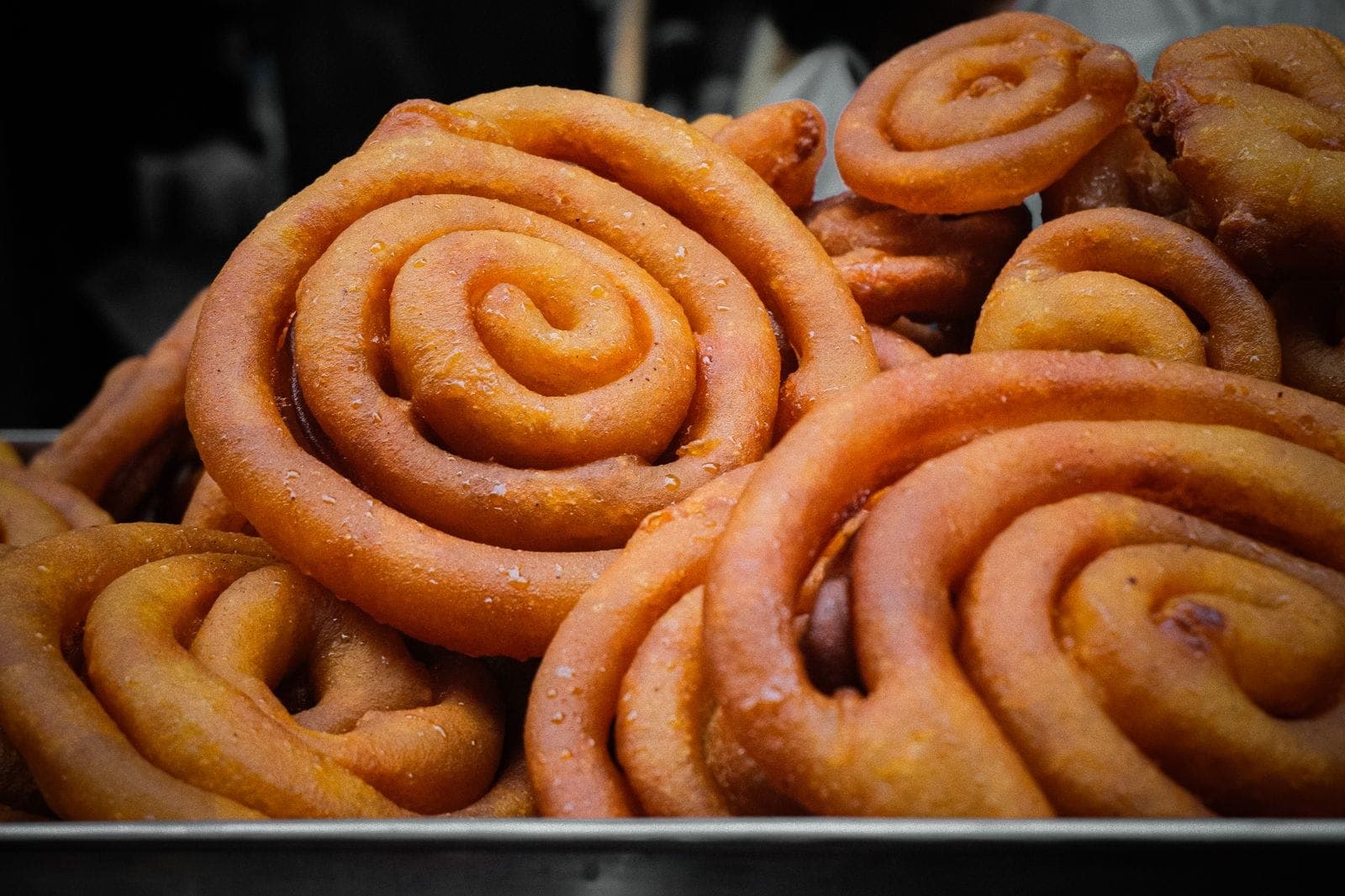
One medium jalebi of about 30 g has 99 calories, or 330 per 100 g. It carries 9.6 g of added sugar from the syrup, about 2.3 teaspoons, and almost no protein. Two pieces come to 198 calories, and a 250 g sweet shop pack to 825.
99calories
Protein
0.8 g
Carbs
15.0 g
Fat
4.1 g
Founding 500
Your jalebi is not exactly 30 g.
Katori is an iPhone app that counts your actual plate from one photo. Built for Indian food first.
No spam. One email at launch, then only if it matters. Privacy.
First 500 sign-ups get the badge, paid or free. 10% off Pro annual, expires 30 days after launch, replaces the trial.
About jalebi
Also called jilebi and jalebi sweet.
Jalebi is a batter of maida and a little curd, piped in spirals into hot oil, fried until crisp and then dipped in sugar syrup while still hot. Our medium piece starts from 7 g of maida. It takes up 4 g of oil in the fryer and 9.6 g of sugar from the syrup, and those two lines carry most of its calories: 36 percent from the oil and 38 percent from the sugar, nearly three quarters together. The flour supplies the rest, along with nearly all of its little protein. Because the batter itself is light, a jalebi's number depends on what it soaks up, first in the fryer and then in the syrup, more than on the size of the spiral.
Home vs sweet shop
Size, fat and soaking time move the number. A sweet shop jalebi fried in ghee and left longer in the syrup comes to 110 calories at 34 g. A large piece is 165, and a jalebi served with rabri, sweetened reduced milk, is 191.
| Version | Weight | Calories | Added sugar | Protein |
|---|---|---|---|---|
| MediumHeadlineFried in oil, dipped in syrup and drained. | 30 g | 99 | 9.6 g (2.3 tsp) | 0.8 g |
| Sweet shop, fried in ghee and soaked longerGhee in place of oil, and longer in the syrup: more fat and more sugar. | 34 g | 110 | 11.5 g (2.7 tsp) | 0.8 g |
| LargeThe medium recipe scaled up by two thirds. | 50 g | 165 | 16.0 g (3.8 tsp) | 1.3 g |
| With rabriOne medium jalebi with a portion of milk reduced by half and sweetened. | 88 g | 191 | 17.6 g (4.2 tsp) | 3.9 g |
| Imarti, the urad batter cousinUrad dal batter in place of maida, fried and soaked the same way. | 30 g | 101 | 10.0 g (2.4 tsp) | 2.0 g |
How much sugar is in one jalebi
A medium jalebi holds 9.6 g of added sugar, about 2.3 teaspoons, all of it from the syrup. Two pieces carry 19.2 g, and with rabri a single jalebi reaches 17.6 g, or 4.2 teaspoons.
| Guideline | What it says | One jalebi, added sugar |
|---|---|---|
| World Health Organization | Free sugars under 10% of daily energy, ideally under 5%, which is about 25 g a day. | 9.6 g, 38% of 25 g |
| NHS (UK) | No more than 30 g of free sugars a day for adults. | 9.6 g, 32% of 30 g |
| American Heart Association | About 6 teaspoons of added sugar a day for women and 9 for men. | 2.3 tsp, against 6 (women) or 9 (men) |
| Heart & Stroke (Canada) | No more than 10% of daily calories from added sugars, ideally under 5%. On a 2,000 calorie day, 10% is about 48 g. | 9.6 g, 20% of 48 g |
| Australian Dietary Guidelines | Limit foods and drinks containing added sugars. No daily number is set. | 9.6 g |
Is jalebi healthy?
Jalebi is fried batter soaked in syrup, and its numbers say so. Of its 99 calories, nearly three quarters come from absorbed oil and sugar, and it has 0.8 g of protein, less than a gulab jamun, kaju katli or rasmalai. A rasmalai, by contrast, carries 6 g. There is almost nothing in a jalebi besides energy, fat and sugar.
Per 100 g it is 330 calories: more than a drained gulab jamun, the other fried and soaked sweet here, at 285, and less than kaju katli at 492.
Size counts as much as the number of pieces. A large jalebi of 50 g is 165 calories, so one large piece is most of the way to two medium ones.
Pairing jalebi with rabri adds protein from the milk, 3.9 g for the plate, but it also adds sugar and calories: 191 in all. One medium piece on its own, counted, is the simplest way to have it.
If you manage blood sugar, ask your doctor or a registered dietitian how a sweet like jalebi fits into your plan.
The two numbers we estimate
Two lines in our recipe are assumptions, and we say so plainly: the oil a jalebi absorbs in the fryer, 4 g, and the sugar it takes up from the syrup, 9.6 g. We found no published measurement of either for jalebi, so both are our estimates for a medium piece, not measured values.
They matter because each gram counts. Every extra gram of oil adds about 9 calories and every extra gram of sugar about 4. A jalebi fried in more fat, or left longer in the syrup, sits above our figure, which is what the sweet shop row shows: fried in ghee and soaked longer, it comes to 110.
If a study ever measures how much oil and syrup a jalebi takes up, we will replace our two estimates with its figures and recompute every number on this page, the way our methodology describes.
Bought by weight from a sweet shop, a 250 g pack is about 8.3 medium pieces: 825 calories, 80 g of added sugar (19 teaspoons) and 34.4 g of fat.
Imarti is jalebi's urad dal cousin, piped in a ring of small loops, then fried and soaked the same way. An imarti of 30 g is 101 calories with 2 g of protein, against 99 calories and 0.8 g for a jalebi of the same weight. The urad batter brings a little more protein; the oil and syrup are the same story.
Jalebi with rabri is a plate of its own: a medium jalebi with milk reduced by half and sweetened, 88 g in all, 191 calories and 17.6 g of added sugar.
Two servings, compared
| Sweet | Two servings | Calories | Added sugar | Protein |
|---|---|---|---|---|
| Gulab jamun | 66 g | 188 | 18.0 g (4.3 tsp) | 4.9 g |
| Rasmalai | 160 g | 292 | 22.0 g (5.2 tsp) | 12.0 g |
| Kaju katli | 20 g | 98 | 8.2 g (1.9 tsp) | 2.1 g |
| Jalebi | 60 g | 198 | 19.2 g (4.6 tsp) | 1.6 g |
Common questions
How many calories are in 1 jalebi?
About 99 calories in a medium piece of 30 g. A large one is 165, and a sweet shop jalebi fried in ghee and soaked longer is 110.
What is jalebi made of?
Maida and a little curd make the batter, which is often left to ferment for a few hours. It is piped in spirals into hot oil or ghee, fried crisp, then dipped in sugar syrup, sometimes flavoured with saffron or cardamom. Our medium piece starts from 7 g of maida and ends up holding 4 g of oil and 9.6 g of sugar from the syrup.
Is jalebi high in sugar?
Yes, for its size. A 30 g piece holds 9.6 g of added sugar, which is 32 g in every 100 g. Two pieces carry 19.2 g, 77 percent of the World Health Organization's ideal daily figure of about 25 g.
How many calories are in 250 g of jalebi?
About 825 calories, roughly 8.3 medium pieces, with 80 g of added sugar and 34.4 g of fat.
How many calories are in 2 imarti?
About 203 calories for two pieces of 30 g, with 20 g of added sugar, about 4.8 teaspoons. Imarti is made from urad dal batter rather than maida, so it carries a little more protein than jalebi.
How many calories are in jalebi per 100 g?
About 330 calories, with 13.7 g of fat, 2.6 g of protein and 32 g of added sugar. That is higher than a drained gulab jamun and lower than kaju katli, whose cashews make it denser still.
Is jalebi fried in oil or ghee?
Both are used. Our medium piece is fried in oil; the sweet shop row assumes ghee and a longer soak, which comes to 110 calories against 99. Gram for gram, ghee and oil carry nearly the same calories, so most of that gap is the extra fat and syrup the piece takes up, not the choice of fat.
Which has more calories, jalebi or gulab jamun?
Per piece they are close: a medium jalebi is 99 calories and a drained gulab jamun 94. Per 100 g, jalebi is higher, 330 against 285, because it carries more fat per gram: 13.7 g per 100 g against 10.3 g.
How we calculated this
Every number on this page is for 1 medium piece (30 g), worked out from the recipe below. A version with its own weight in the table above is worked out at that weight.
- Maida (batter)7 g
- Curd (batter)1.7 g
- Batter water left after frying1 g
- Oil absorbed in frying4 g
- Sugar absorbed from the syrup9.6 g
- Water absorbed from the syrup6.7 g
One medium spiral as eaten, after frying and a dip in the syrup. The batter water left after frying and the syrup water it takes up are counted, so the lines come to the finished 30 g.
Ingredient values from USDA FoodData Central (SR Legacy). The oil and syrup a jalebi absorbs have no published measurement we could find, so both are our stated estimates.
Confidence: medium
Sources
- USDA FoodData Central 168894: Wheat flour, white, all-purpose, enriched, bleached
- USDA FoodData Central 171284: Yogurt, plain, whole milk
- USDA FoodData Central 171411: Oil, soybean, salad or cooking
- USDA FoodData Central 169655: Sugars, granulated
- USDA FoodData Central 173412: Butter oil, anhydrous
- USDA FoodData Central 171265: Milk, whole, 3.25% milkfat, with added vitamin D
- USDA FoodData Central 174259: Mungo beans, mature seeds, raw
- World Health Organization. WHO calls on countries to reduce sugars intake among adults and children, 2015.
- NHS. Sugar: the facts.
- American Heart Association. Added sugars.
- Heart & Stroke. Reduce sugar.
- National Health and Medical Research Council. Australian Dietary Guidelines 1 to 5.
These figures are estimates from stated recipes, for general information. They are not medical or dietary advice. If you manage a health condition, check with a registered dietitian or your doctor.
Related dishes
Founding 500
Be one of the original 500.
Permanent badge, plus 10% off your first year of Pro.
Snap one photo and get these numbers for your actual plate, not a generic entry. Built for Indian food first.
No spam. One email at launch, then only if it matters. Privacy.
First 500 sign-ups get the badge, paid or free. 10% off Pro annual, expires 30 days after launch, replaces the trial.